Artist Birthday: Violet Oakley (1874-1961 US)
Violet Oakley is one of the standout women artists of the American Renaissance. She can truly be called a “Renaissance Woman,” being accomplished in many different media, and working as a portrait painter, illustrator, muralist, and architectural designer, to name a few of her vocations.
Artist Birthday for 10 June: Violet Oakley (1874-1961 US)
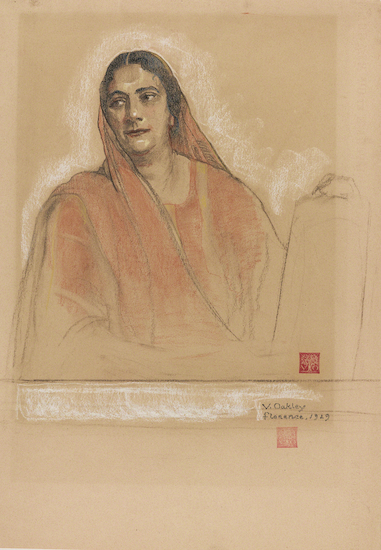 |
| Violet Oakley, Study of Jochebed for the Life of Moses reredos at the Samuel S. Fliesher Art Memorial, Philadelphia, 1929, pastels over charcoal on orange-pink paper, 52.7 x 37.1 cm © 2026 Philadelphia Museum of Art (PMA-8295)
|
Oakley was strongly influenced by Dante Gabriel Rossetti (1828-1882), a British pre-Raphaelite who based his painting style on early Italian Renaissance religious art. Oakley wanted people to have a mystical, uplifting experience when viewing her religious works. She received the commission for the Life of Moses in 1927, and enthusiastically researched ancient Egyptian art as well as Italian Renaissance altarpieces for the commission.
The altarpiece, dedicated to his mother, was located in a church he had acquired, later named the “Samuel S. Fleisher Memorial.” The church interior was Renaissance Revival in style. The subject was based on Fleisher’s admiration for a painting of Oakley’s entitled Moses Carving the Ten Commandments. Oakley’s strident realism and attention to historical detail was a bit out of fashion at a time Art Deco, American Impressionism, and all types of abstraction from Europe were part of the American art scene. This image is a “portrait” of the presumed mother of Moses, Jochebed.
Background
The period between the American Civil War (1860-1865) and 1900 is sometimes referred to as the “American Renaissance.” It was a period of great continental expansion, industrial growth, social awareness, and an increase in the affluence of the middle class. In the arts, the period was one in which increasing numbers of American artists, including women, were traveling to Europe to study their vocation in the numerous museums and art schools that provided American artists a taste of the most progressive styles. Munich, Paris and Rome were major magnets for American artists because of the vitality of their artist communities.
American women artists became increasingly active in art schools both in the US and abroad, although they were still not permitted to attend anatomy lessons with live models. Many women formed “schools” of their own abroad, such as that of a group of American women sculptors in Rome starting in the 1850s. In the US, there were increasing numbers of women artists working professionally as magazine and book illustrators, botanical illustrators, and as fine artists. Many of these women artists of the American Renaissance sought a spiritual revitalization and cultural renewal of American art based on, of course, Renaissance (1400s-1600s) aesthetic ideals.
Violet Oakley, a painter, muralist, illustrator, portraitist, architectural and industrial designer, writer, civic leader, and advocate for many social issues and world peace, was a leading artist of the American Renaissance period. She was born in Jersey City, New Jersey, and moved to Philadelphia to study at the Pennsylvania Academy of Fine Arts. There she studied under the American Impressionist portraitist Cecelia Beaux (1855-1942). She also studied illustration at Drexel University, where she formed an illustration “school” with classmates Elizabeth Shippen Green (1871-1954), and Jessie Wilcox Smith (1863-1935). Living together, these three women worked tirelessly to become independent illustrators and artists.
After Beaux, Oakley was only the second woman hired to teach at the Pennsylvania Academy of Fine Arts. She achieved national fame in 1906 when she became the first woman hired to produce a series of murals to decorate the governor’s reception room in the Pennsylvania State Capitol in Harrisburg. Throughout the first half of the 1900s, she received numerous mural commissions.
Oakley was also active in supporting Philadelphia artist collectives, especially those of women artists. Along with her life partner, muralist and painter Edith Emerson (1888-1981) she was a moving force behind the establishment of the Woodmere Art Museum, the collection of which celebrates Philadelphia artists and culture. This work epitomized her life-long belief that beautiful art in public places could uplift and improve society.

Comments