
Artist Birthday: Weegee (Arthur Fellig, 1899-1968)
Famed crime scene photographer and artist Weegee was know not only for covering gruesome crime scenes in New York, but also for his carefully orchestrated scenes that evoked discomfort or pity by the viewer for the people he photographed.
Artist Birthday for 12 June: Weegee (Arthur Fellig, 1899-1968 US, born Austria)
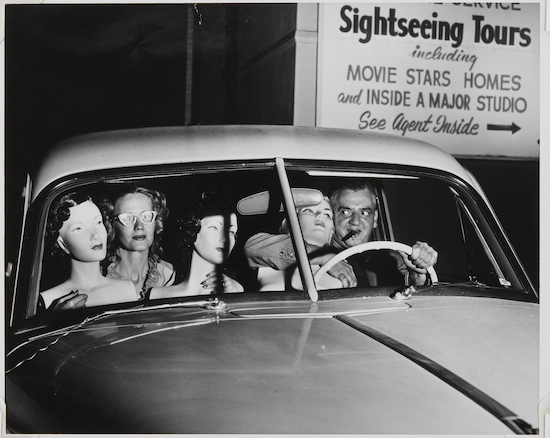 |
| Weegee, Self-Portrait with Mannequins, ca. 1947-1952, gelatin silver print on paper, 19.4 x 24 cm Philadelphia Museum of Art, © 2026 Artist or Estate of Artist (PMA-8387)
|
While in Hollywood, Weegee worked as a technical consultant on films, and worked especially with Stanley Kubrick, a director known to have a similar dark humor to like the photographer. He unfortunately hated his time in Hollywood, calling it a "land of zombies". This self-portrait displays Weegee's sardonic sense of humor, depicting himself with a group of female mannequins that would probably fit his description of "zombies". The use of common commercial objects in a work of art prefigures by at least ten years the work of Pop artists like Warhol who elevated commercial objects ironically to the status of fine art.
Background
As photographic printing techniques and equipment improved in the early 1900s, by the 1920s photographs were becoming an intrinsic part of journalism and advertising, appearing in newspapers and magazines. Documentary photography was further influenced by the "snapshot aesthetic." Small, portable cameras appeared for consumers during the 1930s. This allowed even amateurs to take spontaneous, unposed records of events and people.
During the Depression, documentary photography became very popular as a medium for entertaining the masses during the Great Depression (1929-1940). Documentary was no longer confined merely to social ills, but encompassed a broad range of "straight image" work that chronicled crime, everyday life, sporting events, and news events. Straight photography, which had traditionally been valued as an unchallenged arbiter of visual fact, exhibited subtle changes during the Depression and World War II (1939-1945). Many photographers began to color their photographs with subjective or ironic attitudes. As the great social cause photographer Lewis Hine (1874-1940) had once explained, photography was a light that was required to illuminate the dark places of social existence. Early crime photographers emerged as a novel type of social documentation, and flourished from the Great Depression on. Arthur Fellig, nicknamed Weegee, epitomized the aggressive, unscrupulous crime reporter often depicted in movies from the period.
Weegee was born Usher Fellig in part of Austria that is now Zolochiv, Ukraine. His family emigrated to the US in 1909 where they lived in New York in poverty. At Ellis Island they changed his name to the "more American-sounding" Arthur. Weegee's first experience with photography came when he quit school at 13 to earn money and became an assistant to a pony ride photographer. In 1923 he worked at Acme Newspicture, a leading stock photography outfit, where he received his photographic training.
Weegee established his reputation as a crime photographer from the mid-1930s through 1948. He was known for his lurid crime scene photographs, always seeming to arrive just before the police (a fact that led people to suspect he had a Ouija board in his car, an idea that led him to take the nickname Weegee). He was the first private American to have a police radio installed in his car. His crime photos appeared in at least a half-dozen daily newspapers in New York. In the 1940s, he also focused on the people of the streets of New York, capturing unique expression and gestures of his subjects.
An avid self-promoter, Weegee published a book of his photographs of grisly crime scenes and city nightlife called Naked City (1945) which became an instant classic film noir in Hollywood in 1948. He briefly working in Hollywood as a consultant on movies between 1947 and 1952. Weegee's tabloid style with voyeuristic images of people at their most vulnerable inspired later photographer Diane Arbus (1923-1971) who, like Weegee, favored subjects of people considered outcasts or downtrodden. His overbearing and narcissistic concern about an "artist as celebrity" probably also had an impact on Andy Warhol (1928-1987).

Comments