
Artist Birthday: Christopher Wilmarth (1943-1987 US)
Christopher Wilmarth, in his tragically short life, was a Minimalist sculptor who created over 150 sculptures, most of them made of glass and steel.
Artist Birthday for 11 June: Christopher Wilmarth (1943-1987 US)
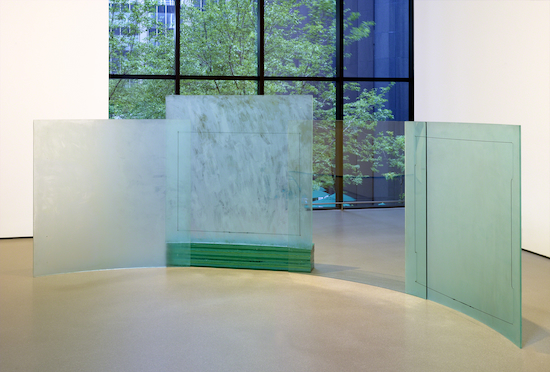 |
| Christopher Willmarth, Tina Turner, 1970-1971, etched glass, clear glass, and steel cable, 177.2 x 449.6 x 147.3 cm The Museum of Modern Art, New York, © 2026 Estate of Christopher Wilmarth (MOMA-S0198A)
|
In New York of the early 1960s, Wilmarth found a landscape full of light, the gleam of the two rivers, and the metallic facades of skyscrapers which had a major impact on his artistic vision. He enjoyed experimenting with the illusory properties of glass by manipulating shape and thickness of glass elements. In Tina Turner, while the glass has an ephemeral quality, it conversely has a solid presence. Light and shadow are tantalizingly variable, but the etched lines in the work bring the viewer’s attention back to its solid surface. The piece is not a literal portrait but rather an abstract tribute to the singer's lithe energy and stage presence. The artist created the flowing, rhythmic arc of glass and steel cables to capture the kinetic, dynamic movement associated with the famous performer.
Background
In the late 1970s, in New York, the artist culture was diverse and vital, although several movements that had originated earlier in the decade persisted in exerting dominance in the “official” art world. What resulted was a group of artists who built on these earlier stylistic evolutions but altered process, materials, and even vision as to what the previous styles could evolve into further.
Minimalism was one style that endures into the present day, but received its first revision in this experimental period of the late 1970s into the 1980s. There was a group of artists working in New York City during the 1970s and 80s who worked in certain styles beyond the historical canon—who shaped the discourse of this era well beyond the established “canon” of Minimalism as it appeared in the works of Sol LeWitt (1928-2007), Brice Marden (1938-2023), Agnes Martin (1912-2004), and Robert Ryman (1930-2019). While steadfast in developing their individual practices, many of the artists in the “second look” at Minimalism avoided categorization into contemporaneous movements.
Christopher Wilmarth is best known for his glass and wood sculptures created in a Minimalist idiom in a Cubist and Constructivist visual language. Born in Sonoma, CA, he was raised in the San Francisco area. In the early 1960s, he moved to New York where he apprenticed in the studio of geometric Minimalist master Tony Smith (1912-1960). Smith, the master of the Primary Structure type of severe Minimalism impacted Wilmarth’s leaning towards Minimalism.
After receiving a BFA from Cooper Union (1965), Wilmarth taught sculpture in 1969. His earliest sculptures were in wood, which he considered derived from the works of Constantin Brancusi (1876-1957), whose sculptures often contrasted both dull and shiny surfaced materials. Wilmarth soon settled on glass as his preferred medium, and was showing wood and glass pieces as early as 1968.
Wilmarth developed a Minimalist visual language of his own. He abandoned the purist Minimalist approach in which the surfaces revealed neither the artist’s personal touch, or any key to narrative. Inspired by French poet and philosopher Stéphane Mallarmé’s (1842-1898) conviction of the intimate connection between form in art and spirituality. Wilmarth’s wood and glass works reflect his ability to create illusory and emotional effects from light working through the glass.

Comments