Artist Birthday: Suh Do-Ho (born 1962 South Korea)
The outstanding history of Korean art continues to the present day with a contemporary art scene that is one of the most vital in the current art world. Suh Do-Ho is an amazing artist whose works confront Korean history as well as conjure up Suh’s lyrical visions of the present.
Artist Birthday for 19 August: Suh Do-Ho (born 1962 South Korea)
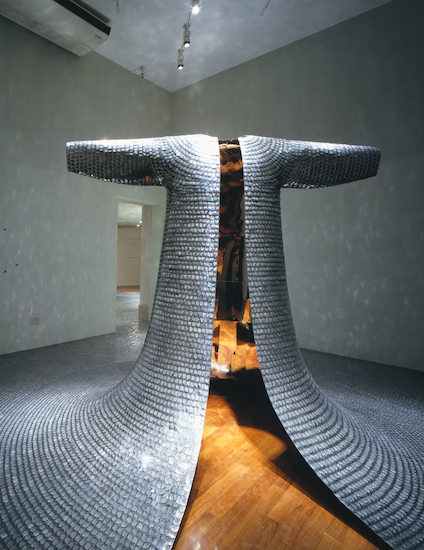 |
| Suh Do-Ho, Some/One, 2001, stainless steel military dog tags, nickel-plated copper sheets, steel structure, glass fiber reinforced resin, rubber sheets, figure 206 x 319 cm Courtesy of the artist and Lehmann Maupin Gallery, New York, © 2026 Do-Ho Suh (ART21DS-81)
|
Many of Do Ho Suh’s works were influenced by his memories of military service, as well as the broader history of South Korea extending back to the Korean War (1950–1953). Some/One is his second work composed of military dog tags, symbolizing the sacrifice of South Korean soldiers as well as his own military service. An earlier, smaller version was titled Metal Jacket. According to the artist, Some/One was also inspired by a dream in which he saw a stadium filled with the dog-tag coat flowing from a single small figure.
The individual dog tags represent the numerous dead soldiers, anonymous in the work, symbolized collectively in the form of an armored robe. This is Suh’s reflection on the personally impactful experience of being a soldier, conscripted against his will and becoming part of a nameless whole. The form vaguely recalls the shape of lacquered armor historically worn by Chinese, Japanese, and Korean soldiers. While the artist intended the work to cause viewers to consider the impersonal nature of war, the mirrors inside the form encourage the viewer to reflect on how the work applies to them personally.
Background
During the Japanese occupation of Korea (1910–1945), the country experienced a marked rise in urbanization and industrialization as well as an increased use of technology. The Japanese defeat in World War II (1939–1945), and the subsequent division of Korea into North and South in 1948, led to the occupation of South Korea by American troops. As it had in Japan, this opened Korean art to a larger, Western patronage, and exposed Korean artists for the first time to a broader range of artistic influence from Western countries, particularly the United States.
Various modernist movements evolved during the 30 years of military dictatorships in South Korea (ca. 1948–1988). In the mid-1950s, a group of young artists formed the group Informel, probably modeled on the European version of Abstract Expressionism called l’Art Informel. Informel valued the spontaneity and subjective expression of both those movements.
Monochrome Art evolved in the 1970s as an attempt to revive traditional Korean art in a Minimalism vein. The painters of Minjung Misul (People’s Art) explored social themes during the 1980s, the decade when South Korea held its first democratic elections.
In the 2000s, the work of contemporary South Korean artists is part of the vocabulary of modernism. Like many countries once (or still) dominated by Western powers, their work documents South Korea’s complex social history, while establishing them as integral voices in contemporary art. There are also contemporary artists whose works reflect a combination of both traditional Korean art forms and contemporary aesthetic.
Do Ho Suh is best known as a sculptor and installation artist. His works, which include video and film, confront questions of home, physical space, displacement, memory, individuality, and collectivity. Born in Seoul, South Korea, Suh received a BFA (1985) and an MFA (1987), both in Asian painting from Seoul National University. In 1993, after fulfilling mandatory military service, Suh moved to the United States, earning a BFA in painting from Rhode Island School of Design, Providence (1994), and an MFA in sculpture from Yale University (1997).
Correlations to Davis programs: Experience Art, lesson 7.1; Davis Collections – Korean Art

Comments