
Artist Birthday: Shimaoka Tatsuzō (1919-2007 Japan)
What with the thousands of years of evolution of Japanese ceramic arts --- some of the oldest developments in ceramics on Earth – it is little wonder that the Japanese have introduced the honorific title on certain cultural icons of National Living Treasure. Tatsuzō Shimaoka is just one such honored artistic icon.
Artist Birthday for 27 October: Shimaoka Tatsuzō (1919-2007 Japan)
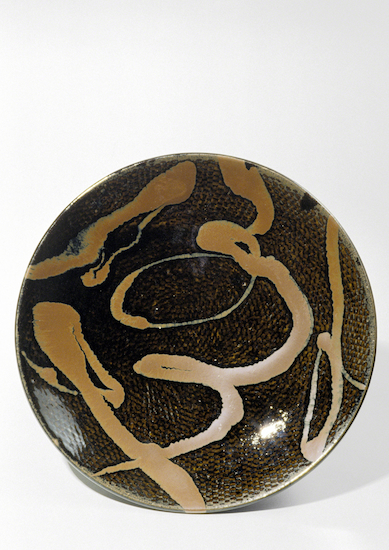 |
| Shimaoka Tatsuzō, Plate, 1980s, stoneware with slip inlay under Tenmoku glaze with kaki (persimmon) ladle pours, width: 35.5 cm Cleveland Museum of Art, © 2026 Artist or Estate of Artist (CL-826).
|
Shimaoka is renowned for his rustic type of Mashiko ware. Mashiko clay is rich in silicic acid and iron, giving the clay great plasticity, and resulting in a thickness with Mashiko wares. Glazes have traditionally been from stone or scrap iron powder. While Shimaoka experiments with various glazes, he is credited with introducing Western-influenced salt glaze technique to Japan.
Shimaoka's work is particularly renowned for the Joman zogan (rope-impressed inlay) decoration of his works. This is a technique of pressing cord or rope into the damp clay to create an all-over pattern, as is seen in this plate. Shimaoka also uses the "slip inlay" technique where a motif is impressed into the damp clay and filled in with white slip (clay mixed with water).
Background
The Japanese tradition of ceramics is one of the oldest on Earth. The Jomon culture, that flourished between 5000-200 BCE, created the first ceramics on the planet that were decorated for decoration's sake rather than ritual purposes. Porcelain developed in Japan during the 1600s, pioneered mostly by Korean ceramic artists who had come to Japan in 1590.
The tea ceremony (chanoyu) and flower arranging (ikebana), influenced by Zen Buddhism, are cultural developments of the 1500s that brought increased respect for the ceramic arts.
In the early 1900s, inspired by the British Arts and Crafts Movement, reacting against the rapid "westernization" and industrialization of Japan, a group of ceramic artists founded the Japanese Folk Art Association. This group of artists promoted the idea of the hands-on ceramic artist, one who took part in every stage of making ceramic vessels.
The need to restore national identity after the disaster of World War II (1939-1945) helped strengthen the movement to fortify traditional art forms. The reverence and respect for ceramic arts in Japan elevated the art form to the same status as painting or sculpture.
Unlike their counterparts in China and Korea, individual Japanese ceramic artists have traditionally enjoyed almost star-like status. This idea has been perpetuated by the government sponsored exhibitions of ceramic art and public recognition of artists who are designated Living National Treasure.
Tatsuzō Shimaoka was born in Tokyo. He studied ceramics at the Tokyo Institute of Technology, and then apprenticed with the legendary mingei (Japanese folk art) ceramic artist Shoji Hamada (1894-1978). After Hamada's death, Shimaoka assumed the mantle of Japan's most revered mingei ceramic artist. Mingei is a term meaning "art for the people." In other words, it refers to artwork that is also functional on an everyday basis. For his contributions to mingei, Shimaoka was named a Living National Treasure in 1996.
Correlation to Davis Program: Experience Clay 3E, Chapter 6 Thrown Forms

Comments