Gem of the Month: Yamamoto Baiitsu (1783-1856 Japan)
During the Song Dynasty (960-1279/1280) the classic tradition of Chinese landscape painting were pretty much a codified aesthetic. Song painting is considered the zenith of Chinese painting which was ultimately emulated by Japanese artists. One of the tenets of what Chinese artists felt a painting should prompt in a viewer was to contemplate taking an mental stroll through the painting to fully appreciate it. This beautiful, lyrical seascape by Yamamoto could really encourage me to take that mental stroll right now!
Gem of the Month: Yamamoto Baiitsu (1783-1856 Japan)
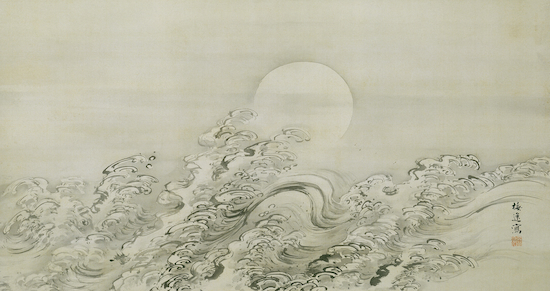 |
| Baiitsu Yamamoto, Waves and Moon, ink on silk mounted as hanging scroll, 61 x 114.6 cm Image © 2026 Philadelphia Museum of Art (PMA-2976)
|
Yamamoto was renowned for his bird-and-flower works and animal subjects. In Kyoto he developed a dedication to the Chinese ideal of the scholar/amateur or "literati" artists who specialized in personal versions of the traditional monochromatic ink painting style. He transformed everything he had learned in Kyoto, developing a personal, individualist style that combined influences of direct observation with the so-called "boneless" (mokkotsu) style, which favored building form with washes rather than contour lines.
Waves and Moon combines his Shijō influence of direct observation of atmospheric conditions in the misty moonlight, and a traditional rendition of stylized waves that can been seen in the work of Ukiyo-e masters such as Hokusai (1760-1849). Compared to the Ukiyo-e style waves, however, the contours of Yamamoto's waves are much softer, reflecting the boneless style.
Background
During the Kamakura (1185-1333) and Muromachi (1392-1573) periods, Japanese painting was heavily influenced by Chinese subject matter, and the scholarly landscape style. After the establishment of a military dictatorship during the Momoyama (1573-1615) period, which lasted through the Edo Period (1615-1868), Japan’s isolationist, no-foreigners-allowed policy fostered a more insular culture. This revived interest in historical Japanese painting styles.
The Kanō School continued to maintain an honored position among the various strains of painting in the Edo Period. The Kanō School artists painted in the decorative, colorful yamato-e style that had evolved during the Heian Period (794-1185).
The traditional monochromatic Chinese landscape style was also popular during the Edo period, both among the Kanō artists and others. The style imitated the individualist scholar artists of the mid-Ming Dynasty (1368-1644), who worked in a suggestive, expressionistic style. This style was called nan-ga ("southern style", referring to the Southern Song dynasty (1127-1279/1280) considered classic Chinese painting period), because it had evolved during the Yuan Dynasty (1280-1368) by refuge artists from the Southern Song period (1128-1280).
Baiitsu Yamamoto was born in Nagoya. From childhood, he was interested in painting. He first studied under Yamamoto Rantei (active 1801-1850), a painter of the Kanō School. After meeting another Nagoya painter, Nakabayashi Chikudō (1776-1853), the two artists went to Kyoto where they honed their skills copying renowned painting works. It was in Kyoto that Yamamoto became interested in nan-ga, and the Shijō School, Kyoto artists who advocated direct observation of nature. He became a professional painter in 1832.
Correlations to Davis programs: Explorations in Art 2E grade 1, lessons 4.4, 4.5; Explorations in Art 2E grade 2, lesson 1.7; Explorations in Art 2E grade 3, lessons 5.4 and 5.5; Explorations in Art 2E grade 4 lesson 3.2; Explorations in Art 2E grade 5, lesson 4.2; Explorations in Art 2E grade 6 lessons 2.2 and 2.3; A Community Connection 2E lesson 4.5; A Global Pursuit 2E lessons 7.1 and 7.5; A Personal Journey 2E lesson 5.4; The Visual Experience 4E lessons 8.1, 8.13; Experience Art lesson 4.2; Exploring Visual Design 5E, lesson 3.3

Comments