
Artist Birthday: Robert Arneson (1930-1992 US)
Robert Arneson was part of the West Coast version of the Pop Art scene. He was also part of the studio pottery movement, which helped raise the profile of ceramics to the level of fine art.
Artist Birthday for 4 September: Robert Arneson (1930-1992 US)
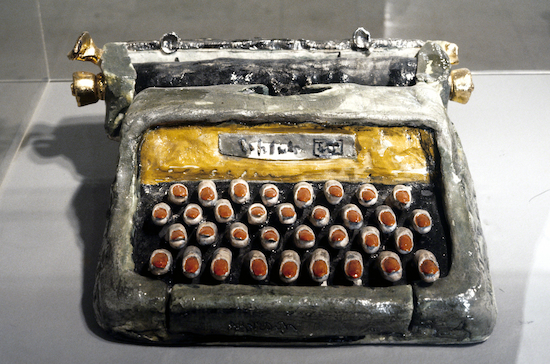 |
| Robert Arneson, Typewriter, 1966, earthenware, 15 x 29 x 32 cm Image courtesy of the Artist, University of California Art Museum, Berkeley, © 2026 Estate of Robert Arneson/Licensed by VAGA at Artists Rights Society (ARS), New York (8s-2960)
|
During the same period Claes Oldenburg (1929-2022) was defining Pop Art sculpture with his food subjects, Arneson was exploring, irreverently, the world of mundane worldly objects such as typewriters, soda bottles, and toilets. Like Oldenburg's work, Arneson's sculptures were cleverly constructed. Unlike Oldenburg's pieces, Arneson's always contained some element of offbeat humor, such as the painted woman's fingernails as keys. The distinction is in the weird transformation of common objects, as opposed to elevation of clever copies of real objects into fine art status.
Background
In the late 1950s, artists who were starting to use junk materials or "the leftovers of human experience," as sculptor Ed Kienholz (1927-1994) called it, were described as "funky" -- or bad-smelling. Like Pop artists on the east coast, Funk artists, centered in California, reacted against Abstract Expressionism, which they considered too removed from humanity. They sought to bring the contemporary art scene back to including some realism and social responsibility. Funk artists liked often to use shock tactics in the Social Realist traditional of cultural critique and demonstrate against.
Born in Benicia, California, Robert Arneson was encouraged by his father to draw. He became a proficient draftsman early in life and drew cartoons for a local newspaper as a teenager. After Arneson studied art education at the California College of Arts and Crafts in Oakland he taught in a local high school, where he became interested in ceramics. He went on to receive an MFA from Mills College in 1958.
The formative influence on Arneson's ceramic work was Peter Voulkos (1924-2002), an artist who helped establish ceramics as "fine art." Although his early pots were conservative, he soon began to create rough, non-functional pots, and by 1960 had broken through to his own mode of expressionist work. The sixties saw several ground-breaking series on subjects as diverse as toilets to bricks. Starting in 1971 he began a series of works in which he used his own face as the vehicle, the work for which he is best known.
Correlation to Davis Program: Exploring Visual Design 4E, Chapter 9 Contrast -- Studio Experience, Pop Art Sculpture

Comments