
Artist Birthday: Richard Estes (born 1932 US)
Like the American Scene works of Edward Hopper (1882-1967), Richard Estes’ Photorealistic views of American cities and towns are virtually devoid of a human presence outside of the evidence of that presence in the built environment.
Artist Birthday for 14 May: Richard Estes (born 1932 US)
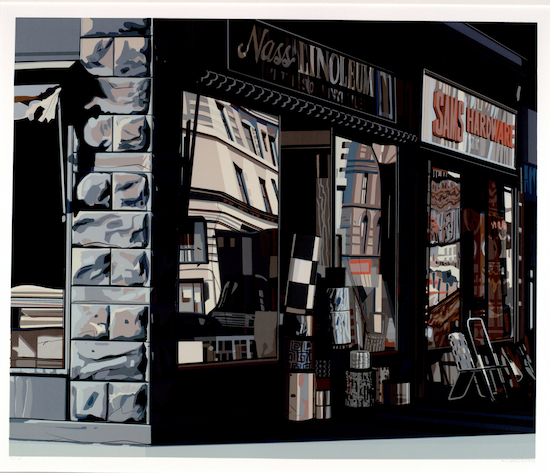 |
| Richard Estes, Sam's Hardware, from the Urban Landscapes portfolio, 1972, silkscreen on paper, 50.2 x 69.9 cm Buffalo AKG Art Museum, Buffalo, NY, © 2026 Richard Estes (AK-4008) |
Although Estes’s cityscapes are based on photographs of actual places and at first appear photographic, they contain perspectives that could not exist in reality. This results in an image that contains multiple viewpoints, more true to what a person perceives than a camera. The lack of human figures in Estes’s cityscapes creates a sense of isolation free of narrative or commentary, an isolation similar to that in the works of Edward Hopper. Thus the built environment and its effect upon the viewer becomes the focus rather than the inhabitants of the city.
In 1971, Parasol Press Ltd contracted with Estes to produce a portfolio of prints. He worked briefly with the historic lithography outfit Mourlot Studio, who had worked with Henri Matisse (1869-1954) and Picasso (1881-1973), before deciding on the silkscreen process. He came to prefer the silkscreen process because of the ability to use opaque colors rather than transparent, that enabled the artist to build up an image much as he did in oils.
Background
Throughout the history of art in the United States, there has been a visual fascination with material reality. The old love of realism in art was too deeply ingrained in the American public to completely die out even with the advent of Abstract Expressionism and Minimalism in the mid-1900s.
From mid-1900s to the present there have always been artists working with the recognizable figure. The most famous of movements to return to figuration was Pop Art in the late 1950s, and New (or, Photorealism) of the 1960s. The movements themselves were a reaction to what was perceived as the domination of Abstract Expressionism in the art world in America.
Since then many artists continue to produce figurative work in a variety of styles. The Photorealism was celebrated with a major 1972 exhibition entitled "Sharp-Focus Realism," a show that included traditional, non-abstract and illusionistic work, many of which, like Estes's work, resembled photographs.
Richard Estes, considered the quintessential Photorealist, was born in central Illinois and later attended the School of the Art Institute in Chicago in the 1950s. There he studied figure drawing and traditional academic painting, although Abstract Expressionism was then the major modernist art style. Estes was interested in realism and figure painting, and studied the work of Dutch Baroque artists, as well as American realists Edward Hopper , Andrew Wyeth (1917-2009) and Thomas Eakins (1844-1916).
In 1956, Estes moved to New York, where he worked as a freelance graphic-design illustrator for magazines and advertising agencies. He painted in his spare time and, by the early 1960s, was able to pursue a full-time career as an artist. Most of Estes’s figurative paintings of this time are scenes of New Yorkers engaged in urban activities. In 1967, Estes moved from city scenes to images of glass storefronts that reflected distorted images of surrounding buildings, the most recognizable aspects of Estes’s work.

Comments