Artist Birthday: Richard Diebenkorn / Happy Earth Day
What better way to dual celebrate Earth Day/Birthday than a landscape! The first original American modernist art movement, called Abstract Expressionism, flourished between the late 1940s into the 1960s. Many artists were either influenced by the movement, or were part of it before moving on to explore their own abstract vision. Painter Richard Diebenkorn was actually criticized by some of the Abstract Expressionists when he returned to figuration in the mid-1950s.
Artist Birthday for 22 April: Richard Diebenkorn (1922-1993 US) / Happy Earth Day 2026
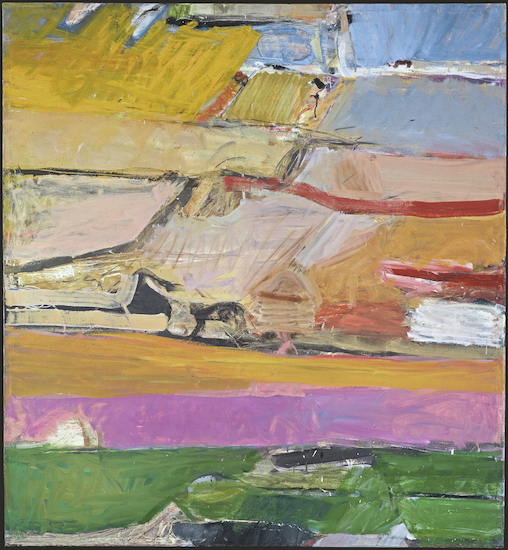 |
| Richard Diebenkorn, Berkeley No.52, 1955, oil on canvas, 148.9 x 136.8 cm National Gallery of Art, Washington, © 2026 Richard Diebenkorn Foundation / Artists Rights Society (ARS), New York (NGA-P0573diears) |
Diebenkorn's paintings of the early 1950s display his personal response to Abstract Expressionism. Like many of his other series of abstract landscapes, the Berkeley series were Diebenkorn's perceptions of his surroundings. The Berkeley paintings are characterized by a horizontal emphasis with the gestural brush work of de Kooning, and the color fields of Rothko, and fluid lines that created a sort of biomorphic abstraction. The horizontal planes give the sense of an aerial view of a landscape. While the pinks and earth tones may recall de Kooning's work, they were actually influenced by the desert landscape of New Mexcio.
Berkeley No. 52 is one of the last of this obviously landscape-inspired series. By 1957 he was producing works with obvious reference to observed subjects, influenced by Bay Area Figuration artists David Park (1911-1960) and Elmer Bischoff (1916-1991). Ironically, Diebenkorn renewed his commitment to abstraction in the 1970s and 1980s with his Ocean Park series of over 140 paintings that emphasized formal concerns rather than response to his environment.
Background
Many American artists of the late 1940s and late 1950s were influenced by Abstract Expressionism in the early stages of their careers, but did not live in, or only visited New York. Many of these artists returned to their native states, some of them persisting in Abstract Expressionism-influenced styles or abstraction based on Abstract Expressionism's emphasis on pure abstraction with little or no reference to subject.
Other artists revisited figuration. In California, one group of artists developed a painterly realistic style. It was as much a reaction to the international big to-do over Abstract Expressionism, as it was a conscious effort to establish an indigenous California "school." One style that developed was termed "Bay Area Figuration," centered in the San Francisco area. Ironically, Diebenkorn's foray into figuration was short lived as he turned to landscape. His simplification of landscape led him back to abstraction.
Diebenkorn was born in Portland, Oregon and raised mostly in California, where he spent most of his life. His childhood fascination in art included medieval tapestries and heraldry, and the illustration style of N.C. Wyeth (1882-1945). He studied art formally at Stanford University 1940 to 1943, where he was exposed to the realism of American Scene painter Edward Hopper (1882-1967), the personal fantasy imagery of Marc Chagall (1887-1985) and the Surrealism of Max Ernst (1891-1976). From 1946 to 1947 he studied at the California Institute of Fine Arts in San Francisco under the painterly realist David Park (1911-1960). Park's work consisted primarily of the human figure executed with fluid, gestural brush work.
During the early 1950s, Diebenkorn went to New York and became aware of Abstract Expressionist Robert Motherwell (1915-1991) and Abstract Surrealist William Baziotes (1912-1961). He did not discover Willem de Kooning's (1904-1997) work until 1948. De Kooning was the only Abstract Expressionist who painted landscapes. Diebenkorn received a masters degree in painting from the University of New Mexico in Albuquerque 1950 to 1951. After teaching in Illinois two years, he returned to California, settling in Berkeley.
Correlations to Davis programs: Explorations in Art 1E, grade 2, lesson 3.18 ; The Visual Experience 3E, lesson 6.13; Discovering Art History 4E, lesson 17.1

Comments