Artist Birthday: Ricci Albenda (born 1966 US)
During the 1960s, many artists experimented with forms of art that transformed the space in which works of art are exhibited, through lighting, placement, and installation. In the 21st century, artist Ricci Albenda has explored using video to created imaginary spaces.
Artist Birthday for 24 June: Ricci Albenda (born 1966 US)
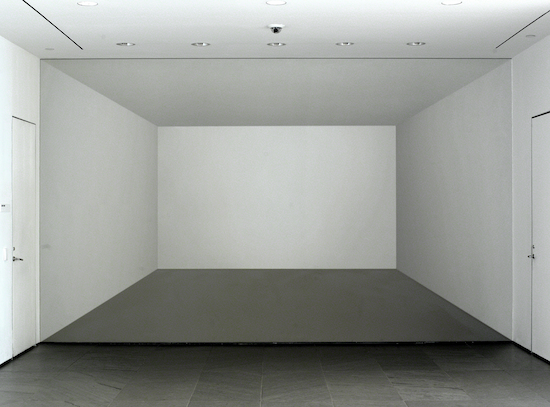 |
| Ricci Albenda, Panning Annex (Albert), 2oo7, video (color, silent), variable duration The Museum of Modern Art, New York, © 2026 Ricci Albenda (MOMA-P4356)
|
Ricci Albenda’s video projection Panning Annex, a 360-degree loop, creates a trompe l’oeil extension of the gallery where one half of the space appears to shift and warp. Like his paintings of words and phrases, Albenda’s video work demands that the viewer reevaluate perceptions of common reality — in this case, the space of the gallery in which they stand. In Panning Annex, the apparent shape, depth, and scale of the gallery are continuously distorted. While the illusion does not last for long, the work destabilizes the viewer’s perceptions. Somewhere between falling for the illusion and making sense of the projection, Albenda says, is where one gets to experience “more than one reality.”
Background
The use of light in or as a work of art has been explored periodically since the early 1900s. Light was typically used in simple ways such as devices that were programmed to produce shifting patterns of colored light. These experiments originated in the Bauhaus in the 1920s with the motion and light experiments of Lázló Moholy-Nagy (1895–1946) and in America by the inventor of the color organ, Thomas Wilfred (1889–1968).
Ricci Albenda was born in Brooklyn, New York, where he now lives and works. He has explored the ways the written word is simultaneously a visual, personal, communal, and intellectual entity. He is also known for his “alphabetic colorization system,” which uses an associative application of color to add narrative to seemingly innocuous words and phrases. He received a BFA from the Rhode Island School of Design in Providence in 1988.
Along with his linguistic pursuits, Albenda has continued to explore perception, initiating in 1998 a series of sculptures, wall paintings, and videos in an ongoing series called Portals to Another Dimension. His paintings and videos negate the accepted reality of flat surfaces and the assumed dimensions of the viewer’s space.
Correlations to Davis Programs: Experience Art, lesson 8.3; Davis Collections -- Media / Technology Arts

Comments