Artist Birthday: Raymond Pettibon (born 1957 US)
Raymond Pettibon’s influential body of work engages a wide spectrum of American iconography. Intermixing image and text, his drawings engage the visual rhetorics of popular and commercial culture while incorporating language from mass media as well as classic literature.
Artist Birthday for 16 July: Raymond Pettibon (born 1957 US)
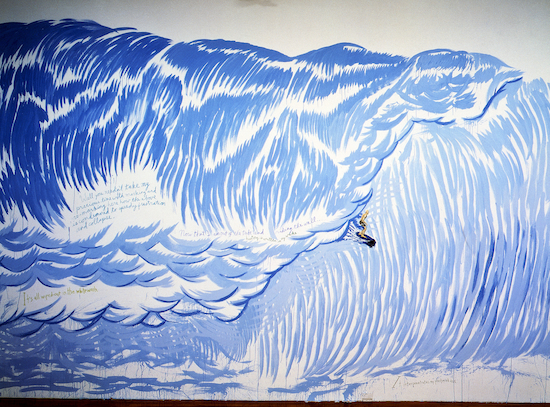 |
| Raymond Pettibon, No Title (Well, you needn’t…), detail, 1997, acrylic wall painting, ca. 213 x 916 cm. Installation at David Zwirner Gallery, New York, Courtesy Regen Projects, LA, © 2026 Raymond Pettibon (ART21RP-70) |
Pettibon’s methodology is a focused examination of the relationship between figurative subjects and text in narrative works. His work has transformed contemporary ideas about the tension between text and image. Raised in Hermosa Beach, California, surfing was a major part of Pettibon's childhood. In 1985, Pettibon began his iconic series of waves, popular for its frequent depiction of the lone surfer silently carving “a line of beauty” along an impossibly large wave. He has produced dozens of works with the surfing metaphor, including beautifully rendered wall-drawings in brilliant color.
Pettibon equates surfing as a sublime example of commuting with nature at its wildest. Stating that the surf works are the ultimate depictions the "man alone at sea," There is also a sense that the artists imparts to surfing a unique moment of being liberated from everyday concerns when riding a wave. Pettibon's surfing works recall artists throughout the history of art, both East and West, who have combined single human figures with the pounding waves of the ocean to suggest humanity's being dwarfed by the power of nature.
Background
In the second half of the 1900s in American painting, the prevailing trend of various types of realism was challenged successfully by Abstract Expressionism. After roughly fifteen years of domination, Pop Art and Photorealism arose as successful challengers to the action painting and color field of Abstract Expressionism. Minimalism and Conceptualism challenged the very value of the physical painting, emphasizing the aesthetic idea rather than the resulting object.
In the late 1970s and 1980s, Neo-Expressionism and Postmodernism returned to figuration. By the 1980s, many artists committed to abstraction reasserted its relevance not only to painting and the tradition of modernism, but also in its continued ability to articulate the boundaries of the art form and its aesthetic and ideological potential.
One of the most irritatingly persistent distinctions among art historians is the division between “fine art” and other forms of visual expression. Postmodernism went a long way in demonizing such distinctions. Raymond Pettibon, too, torpedoed the distinctions between “fine” art and non-traditional forms of two-dimensional visual expression with inventive narratives blending historical content with consumer culture to yield incisive critiques of contemporary society.
Born in Los Angeles, Pettibon earned a degree in economics (1977) from UCLA, teaching math briefly in a middle school. In the 1980s, he took the plunge to become a full-time artist. His early work was his own illustrated magazine (Tripping Corpse, 1981-1986), and graphics for hardcore bands. He settled on an eclectic style influenced by underground comics producing drawings, text, and artist’s books. In the 1990s, he extended his works to the walls of exhibition spaces, creating wall-sized drawings.
Pettibon’s work is an amazing amalgam of themes from art history and classic literature, appearing with images from contemporary pop culture. Some of the artist’s muses from whose works he quotes text include Henry James, Mickey Spillane, Marcel Proust, and William Blake, among others. The fact that Pettibon’s work fits as neatly in art museums and galleries as it does on punk music graphics is indicative of the cross-cultural exchanges that evolved in art starting in the 1990s.

Comments