
Artist Birthday: Niizuma Minoru (1930-1998 Japan)
Minoru Niizuma came to the US after WW II to further investigate modernism. He quickly became one of the more significant abstract sculptors. His respect for materials and reflection of Japanese aesthetics links him to another prominent Japanese-American sculptor, Isamu Noguchi (1904-1988).
Artist Birthday for 29 September: Niizuma Minoru (1930-1998 US, born Japan)
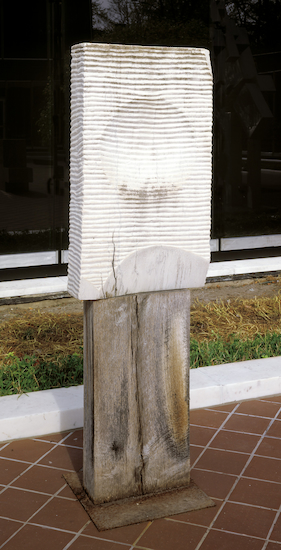 |
| Niizuma Minoru, Ancient Song, 1966, Vermont white marble with wooden pedestal, height: 94 cm Buffalo AKG Art Museum, Buffalo, NY, © 2026 Artist or Estate of Artist (AK-517)
|
Niizuma worked in many series, focusing mostly on refining and producing numerous iterations of single forms which border on symbolic figuration or a totemic aesthetic. Like Ancient Song, most of his works are contrast studies of smooth ad rough textures. His works range from strictly geometric to organic forms, often highlighting natural flaws that reflect a Zen aesthetic about spontaneity of expression.
Niizuma was captivated by the inherent beauty of his materials, and his works were meant to reveal the hidden qualities of the stone. Works such as Ancient Song are reflective of both Western Minimalism and also the centuries old tradition of reverence for nature and its materials. This emphasis on the medium's natural qualities reflects similar aesthetic to the work of Japanese American artist Isamu Noguchi (1904-1988).
Background
After the crushing defeat of Japan in World War II (1939-1945), young Japanese artists did not care to return to traditional arts and the militaristic past that it symbolized for them. The Western occupation opened the door to a myriad of cultural influences that could not but help affect a drastic change in Japanese art, particularly with the revived postwar economy.
After the war, Japanese artists found many new technologies from the West: new colors, synthetic media, and printmaking techniques. They also eagerly absorbed a variety of new conceptual ways of working, including such avant-garde styles as Surrealism and non-objective abstraction. Surrealism in particular had a major impact on Japanese visual as well as literary arts. Surrealism, and its later kindred spirit Pop Art, with their juxtaposition of real and subconscious imagery, gave Japanese artists the avenue in which to tap into traditional, subliminal aesthetic perceptions in new and exciting genres of expression.
The Fluxus group (formed ca. 1962), one of the most radical of the Western postwar art movements, even found its Japanese counterpart in the loose artists' coalition Hi Red Center. These groups shared in a common distrust of the commodity aspect of art (particularly the monetizing of the American Abstract Expressionist movement). Like Dada and Nouveau Réalisme, Hi Red Center sought to question established Japanese perceptions of art, by passing the established commercial processes, and incorporate art into everyday life through Happenings and non-traditional groupings of throw-away everyday objects.
Minoru Niizuma was born in Tokyo. He studied at the Tokyo National University of Fine Arts and Music, and had early success with his sculpture in Tokyo exhibiting with the Modern Art Association. In 1959 he immigrated to New York, where he began teaching sculpture at the Brooklyn Museum Art School in 1964. Once in New York, he was drawn to Minimalism because of its emphasis on simple form. Niizuma's work was inspired by traditional Japanese mingei (folk art), textile patterns and ancient Japanese ceramics. His interest (reverence) for nature connects Niizuma's work also to Land Art.

Comments