Artist Birthday: Larry Poons (born 1937 US)
The paintings of Larry Poons lie somewhere between Color Field and Minimalism, with a dash of action painting thrown in at some times. His paintings of the last 30 years have revealed exciting, lively surfaces and build-up of impasto.
Artist Birthday for 1 October: Larry Poons (born 1937 US)
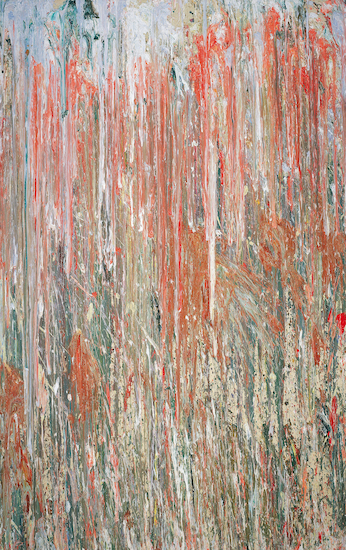 |
| Larry Poons, Getting Straight, 1975, acrylic on canvas, 274.3 x 175.3 cm Buffalo AKG Art Museum, Buffalo, NY, © 2026 Larry Poons / Licensed by VAGA at Artists Rights Society (ARS), New York (AK-165povg)
|
In 1966, reacting against art dilettante Clement Greenberg’s (1909-1994) published views that abstraction was best presented in closed compositions, Poons returned to exploring the nature of tactile (touchable) pigment, which he considered the "essence" of painting. Abstract Minimalist Jules Olitski (1922-2007) – who utilized spray-staining, masking, overs-praying and heavy impasto – was a major influence of Poons’ subsequent works that were dubbed “elephant skin” paintings.
In 1969 he began to pour paint on canvases on the floor, which would wrinkle and crack when dried. Discovering he could achieve effects of layering and banding working vertically, he tacked his canvases to the wall and threw paint at them, allowing gravity to create a cascading aesthetic. These markedly built-up surfaces, like Getting Straight – led Poons in the late 1970s to incorporate all sorts of objects and materials to surfaces that extended dramatically into space.
Background
A number of exhibitions held in the 1960s highlighted changes occurring in American abstract painting. Abstract Imagism, Systemic Painting, and, the most enduring, color field painting, were terms used to identify this new trend in abstraction. The broader term of post-painterly abstraction was applied to the work of this group of painters to differentiate the trend from the action painting of Abstract Expressionism. The exhibitions illustrated just how many younger painters were trying to break with what they felt was the dominance of Abstract Expressionism’s emphasis on individual, personally charged brush stroke.
While artists used many different approaches, the emphasis was on pure abstract painting, with a subordination of brush stroke and paint texture. One of the logical end results of color field painting was a movement which took the emphasis on flat surface rather than illusion and the idea of the artwork as an object to its greatest extreme of reduction -- Minimalism. The paintings of Larry Poons could be seen as cross-over between Color Field and Abstract Expressionism and Minimalism.
Larry Poons was born in Tokyo to American parents who brought him to the US when they returned in 1938. Initially interested in composing music, Poons studied at the New England Conservatory of Music in Boston (1955-1957). Never comfortable with serious composing of music, he experienced an epiphany in 1959 when he saw an exhibition of the work of Abstract Expressionist color field painter Barnett Newman (1905-1970) in New York. That same year he enrolled in the School of the Museum of Fine Arts, Boston, and later he studied at the Art Students League in New York.
Poons gained attention between 1962 and 1963 in New York for his first dot paintings that consisted of large, unnuanced fields of brilliant color with dots and ovals organized floating above invisible grids. In 1965 his work was included in the groundbreaking Op Art exhibition The Responsive Eye at the Museum of Modern Art in New York. Because the dots create the illusion of hovering above the color ground, his work was considered “optical”.
Between 1966 and 1968, considering the optical approach too restricting, Poons began investigating the very nature of paint itself, introducing more gestural circular shapes in works, as seen in 1968’s Brown Sound (Philadelphia Museum of Art). In the 1970s and beyond, in a far cry from his Minimalist optical works, he began to explore splashed and subsequently brushed works where color and build-up of paint dominate the aesthetics. He returned completely to brush work in the 1990s and has explored various other surface augmenting processes well into the 2020s.

Comments