Artist Birthday: Kusakabe Meikaku (1838-1922 Japan)
Meikaku Kusakabe unfortunately was born too early to be voted a Living National Treasure in Japan, an honor inaugurated in 1953, that he surely merited. But he was a universally recognized as a calligraphy master. Calligraphy has been an honored form of fine art forever in Japan. Calligraphy artists in Japan are called shodoka or shoka. This means literally person of shodō, or, person of calligraphy. Traditionally, calligraphers went through the same apprenticeship with established artists as any other art form. Instead of the student/mentor tradition, contemporary calligraphy artists can attend schools with dedicated calligraphy programs, such as Tokyo Gakugei University or Daito Bunka University
Artist Birthday for 6 October: Kusakabe Meikaku (1838-1922 Japan)
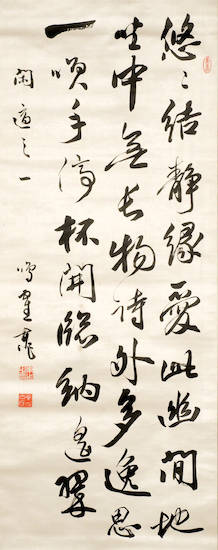 |
| Kusakabe Meikaku, Poem, ink on satin, mounted as hanging scroll, 132.4 x 52.4 cm Image © 2026 Philadelphia Museum of Art (PMA-4729)
|
Written in a flowing semi-cursive script (gyosho), Kusakabe Meikaku's paean to the life of reclusion gives ample testament to the high reputation he earned during his career. A member of the early Meiji government, Kusakabe served as cabinet first secretary to Okubo Toshimichi (1830 - 1878). The latter's assassination led Kusakabe to the life of literati retirement, and until his death he was considered the foremost calligrapher of the time. He traveled to China to study with leading calligraphy masters on the continent.
This piece comprises a Chinese verse in six lines of five characters each. The stately spacing and elegant brushwork reflect the atmosphere of peace and tranquility described in the verse, which translated reads:
Leisurely I have an affinity for peace; I am fond of this quiet, secluded place; In my house there is nothing superfluous; In my poems there are a lot of untrammeled thoughts; Giving a smile, I stay my hand (from drinking) And open the window to let in the distant verdure. From Leisurely Enjoyment, Meikaku
Background
Chinese characters had been incorporated into Japan from the 400s through the 700s CE. Initially, Japanese calligraphy was called karayō shodō or "Tang (dynasty) style." The oldest extant Japanese script is dated 615 CE, a commentary of the Lotus Sutra composed in standard Chinese script. Although the imperial court in Kyoto encouraged the use of Chinese characters in literature and official documents, by the end of the Heian period (792-1185), the wayō shodō -- Japanese style -- was already developing.
The period of the late 800s through the 900s is sometimes called the era of the Three Brushes named for three prominent calligraphers who helped shape the Japanese style. Of the three, the contributions of Ono no Kichikaze (894-966) are considered the most important, and he thought to be the first person to form a truly unique Japanese style called wayō shodō.
Over time, three forms of calligraphy became popular, with individualists of course adding their own flare to the cursive examples. Kaisho is the rigid, block-like characters that most resemble Chinese characters; Gyosho is a semi-cursive form characterized by rounded and semi-joined forms; and Sosho is the completely, expressive cursive script where characters flow together, imitating wind blowing through grass. The Japanese cursive style was a natural result of the increasing need of artistic expressiveness in calligraphy that would accompany gestural landscape paintings.

Comments