Artist Birthday: Kobayashi Kiyochika (1847-1915 Japan)
Kiyochika Kobayashi was undoubtedly one of the late, great masters of the Ukiyo-e style in the late 1800s Japan. He brilliantly blended tradition with Western influences.
Artist Birthday for 10 September: Kobayashi Kiyochika (1847-1915 Japan)
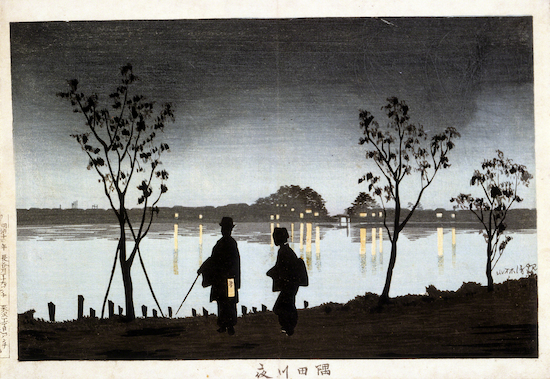 |
| Kobayashi Kiyochika, Evening Along the Sumida, from the series Famous Views of Tokyo, 1881, color woodcut print, 23.4 x 33.2 cm Image © 2026 Worcester Art Museum (WAM-527)
|
Kiyochika was undoubtedly influenced by Hiroshige's (1797-1858) series 100 Famous Views of Edo, which continued to be issued even after that artist's death. This print is reminiscent of Hiroshige's Night View of the Matsuchiyama and the San'ya Canal from that series. The San'ya canal appears as the vanishing point in this print's background. Technically, Kiyochika used Hiroshige's technique of rubbing off excess ink from the woodblock to create heightened nuances in light and dark (chiaroscuro). He also has a screen of trees and silhouetted figures as his foreground, a compositional technique also used by Hiroshige. The emphasis on gaslight street and house lighting -- a result of the rapid modernization of Japan -- however, creates a mood in these prints quite different from Hiroshige's.
Background
The Tokugawa Shogunate (military dictatorship), the period called the Edo Period because of their base in Edo (Tokyo) as capital, ruled from 1615 until 1868 effectively isolated Japan from most foreign contact for over 200 years. During the long period of peace and prosperity, the Japanese turned to native artists and craftspeople to satisfy their needs. The subsequent increase in the prosperity of the middle class merchants and tradesmen who supplied the services. This increased a demand for art by people who traditionally could not afford it.
The Edo period saw a flourishing in all of the arts, particularly the art form of woodblock printmaking. Unlike the nobility, the middle class desired to see scenes of their everyday experiences and pleasures, rather than esoteric, contemplative landscape paintings that were the province of the wealthy. The color woodcut prints that documented the dynamic urban life of Japan were called Ukiyo-e.
Ukiyo-e means "pictures of the floating world," floating in the Buddhist sense of the transience of earthly pleasures. The earthly pleasures depicted in these woodblock prints reflected the glittering entertainment districts (yoshiwara) of Japanese cities: its Kabuki theaters, restaurants, tea houses and shops. Eventually, however, Ukiyo-e subject matter extended into genre scenes, landscape and literary illustration.
Early Ukiyo-e images were painted, but with demand high, artists turned to the woodblock medium. Initially these prints were black and white or three color. By 1764, the multiple block process (often as many as twelve for one print, with a different color printed from each block) was perfected, creating the nishiki-e or “brocade picture”, so named for the wide range of colors available to an artist. They were also used as advertisement for the Kabuki theater.
The Ukiyo-e style persisted through the 1800s into the early 1900s. During the Meiji Restoration (1868-1912), a period which nominally restored power to the emperor, the genre of Ukiyo-e woodblock prints continued, infused greatly with the influence of Western art. The yō-ga artists imitated Western styles and compositions, while artists of the Nihon-ga movement stuck with traditional Japanese subject matter, styles and techniques.
Kiyochika Kobayashi was 21 when the Tokugawa shogunate was overthrown by the samurai class who placed the government back with the emperor, but also eagerly pursued modernization and Westernization to pursue a military agenda. Although he could never afford professional training in either painting or printmaking, he emerged as a print artist around 1874 in Edo (now renamed Tokyo). He quite rapidly became a woodblock print artist of some note.
Like other Nihon-ga artists, Kiyochika resisted the inclination to work completely in a Western style and process. He preferred traditional landscape and cityscape views, infused with Western influences. They are unmistakably Japanese in subject and composition. His greatest undertaking starting in 1876 was his Famous Views of Tokyo featuring 93 views of the capital.

Comments