
Artist Birthday: Käthe Kollwitz (1867-1945 Germany)
The deeply empathetic works of German Expressionist Käthe Kollwitz reflect not only the sensibilities of a highly sophisticated printmaking artist, but also a compassionate and caring mother deeply affected by the World War I (1914-1918) death of her son. Her prints reveal a strong connection to the struggles of working women.
Artist Birthday for 8 July: Käthe Kollwitz (1867-1945 Germany)
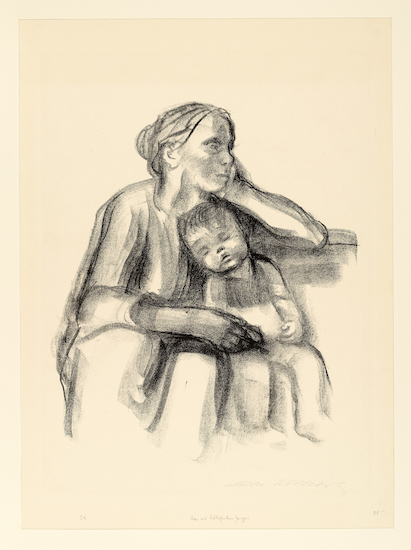 |
| Käthe Kollwitz, Woman Worker with Sleeping Boy, 1927, lithograph on paper, 39.3 x 33.4 cm The Museum of Modern Art, New York, © 2026 Artists Rights Society (ARS), New York (MOMA-P0648kzars)
|
Kollwitz's earliest lithographs were part of a series (1893-1897) on an ill-fated weavers' rebellion in Silesia in the 1840s. Increasingly after 1920, Kollwitz chose lithography for her printmaking because of the gestural possibilities that heightened the emotive power of the subject, and the ease with which the lithographic wax crayon could achieve dramatic contrasts of dark and light with startlingly subtle nuances. Kollwitz's interest in the hardships of working women often played into the simplest of genre scenes. This drawing of a mother and child is forcefully expressed in thick, gestural contour lines. Like most of her subjects, it plays against a blank background to focus all attention on the issue. For poor, working women, taking care of children was a constant anxiety and hardship.
Background
Expressionism in northern European art of the early 1900swas an offshoot of art movements in the late nineteenth century that emphasized romanticism, expressive color, or symbolic (rather than representational) subject matter. The objective in Expressionist work was to express the artist’s feelings about the subject and to elicit an emotional reaction from the viewer.
Kollwitz was one of the leading graphic artists of the first half of the first half of the 1900s. Her father recognized her talent for art, particularly drawing, at an early age, and encouraged a career in art. She received her first training at fourteen in her native city of Königsberg under an engraver in a conservative, rather academic style.
Kollwitz continued her education in Berlin where she was exposed to the work of symbolist artists which impressed her. However, Kollwitz was only influenced by the graphic techniques she saw in Berlin, not by any particular style. She also studied sculpture in Paris.
Kollwitz‘s emphasis on the suffering of the common person, particularly women, demanded realism. Her marriage to a doctor in a poor quarter of Berlin exposed her constantly to the struggles of the poor. Personal tragedies, including the death of a son in World War I gave her body of work an overall somber aspect.
Also a great influence on Kollwitz was the work of Edvard Munch (1863-1944), a Norwegian expressionist whose work emphasized the plights of humanity. Although Kollwitz also became a competent sculptor, she preferred the graphic medium, one with a strong tradition in German art going back to the Renaissance.
She first exhibited in 1893 at the Free Art Exhibit in Berlin, where she continued to do so until the Nazis banned her art in 1936. Her graphic works were published in many socially aware magazines, including the satirical Simplicissimus. Although not interested in contemporary art movements such as German Expressionism or French Fauvism, Kollwitz was not insensible to the expressionistic impact possible with the use of jagged, slashing line, compressed compositions, and stark contrasts in dark and light.
Early in her career, Kollwitz became interested in the story of the weavers’ strike in Silesia of the 1840s, and the prominent role women played in the uprising. It began a life-long fascination with depicting the lot of working women. Based partly on the women Kollwitz saw waiting to see her physician husband, she developed a type that endured throughout her career -- a gaunt face, sunken eyes, and tight knotted hair.

Comments