Artist Birthday: Jonas Lie (1880-1940 US, born Norway)
Jonas Lie was a prominent poster artist during the American Poster “Renaissance” in the early 1900s. He is best known for his patriotic paintings of the American effort in World Wars I (1914-1918) and II (1939-1945).
Artist Birthday for 29 April: Jonas Lie (1880-1940 US, born Norway)
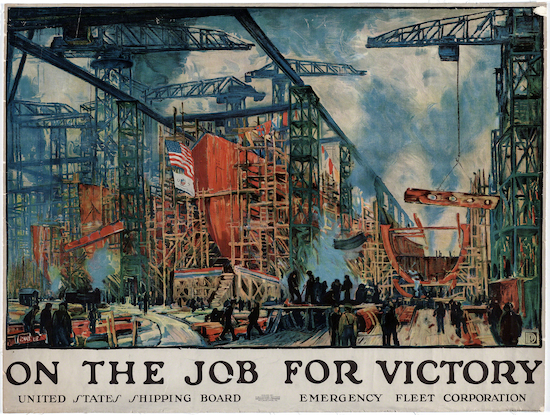 |
| Jonas Lie, On the Job for Victory, 1916-1918, gouache-lithograph on paper, 73.7 x 96.5 cm Image © 2026 The Museum of Modern Art, New York (MOMA-D0371) |
In 1913, Lie traveled to Panama where he produced thirty paintings of the Panama Canal project. This series combined his interest in the everyday working person toiling in industry along with the brilliant color palette that typified his posters and paintings. The paintings of the Panama Canal were a critical success and one of the reasons he was awarded propaganda work on war bond posters during World War I (1914-1918).
The Panama Canal series of paintings established Lie's credentials as a patriotic American artist capable of producing uplifting scenes of American industry. He produced several posters for the War Department during the war what showed the massive effort by American industry to catch up with the German war machine. The mixture of realism and Impressionism are a hallmark of Lie's poster work where he depicts the background of the shipyards in hues of greens and blues to indicate atmospheric perspective. The plunging diagonals of the steel girders above the activity establish a dramatic linear one-point perspective that draws the eye into the composition.
Background
Posters are the direct descendants of broadsides. Broadsides were issued to post public decrees, government directives, and commercial announcements. The earliest were produced either with moveable wooden type and woodcut illustrations, or, later, through the etching or engraving printmaking process.
Because broadsides were meant to be eye-catching from a distance in public, new ways to produce larger type were needed. Metal type could not be cast larger than 2.5 cm (1") and retain a flat surface, and larger metal type was too heavy and expensive to produce. Large wooden type moveable letters were perfected in the 1800s, but this was well after the invention in 1796 of the lithograph by Alois Senefelder (1771-1834). Printmaking processes were a natural and easier application for advertising such as business cards, advertisements in newspapers, and handbills.
Lithography was the first new printing process in the West since the invention of woodcut and intaglio processes. A design was drawn on a stone "plate" in waxy pigment that attracted the ink. The process promptly became popular for advertising and illustration because of the wide range of nuances possible. It was also an easier process to mass-produce images for magazines and books because it did not involve carving out the image from a plate.
The first color lithographs, resulting from printing the same image on multiple stones, each with a different color, began to evolve as early as the 1840s. The most sophisticated of color lithographs could use up to twelve stones. By the beginning of the 1900s, the genre of the "art poster," wherein classically trained artists designed posters for advertising, was a well-established tradition. The American post "renaissance" emerged during the 1890s, about the same time as in Europe, lasting until the 1940s.
Jonas Lie, born in Moss, Norway, was the son of a civil engineer. He received drawing instruction initially from a cousin, then attended a private art school in Paris. In 1893 he moved to New York where he studied painting and drawing at a private school. He also studied nights at the National Academy of Design, Cooper Union and Art Students League. At the time, Impressionism had an impact on the curriculum outside of the National Academy, and influenced his painting style.
In 1906, Lie went to Paris where he was greatly influenced by Claude Monet's (1840-1926) use and color and light. Upon returning to the US, he painted and entered shows, supplementing his living by designing dress shirts and producing advertising art. During this time he applied an Impressionist palette to subjects that reflected the impact of the Ash Can School's interest in realistic urban views. In 1913, he showed his work at the famous Armory Show, which he also helped organize. It was the first exhibition of European modernism in America.
Correlation to Davis program: Communicating Through Graphic Design 2E, Chapter 3

Comments