
Artist Birthday: John B. Storrs (1886-1956 US)
John Bradley Walker Storrs is an example of an American artist who, after exposed to European modernism at the dawn of World War I, he never looked back to realism. He ultimately developed a Cubist abstract style influenced by geometric forms from modern industry.
Artist Birthday for 25 June: John B. Storrs (1886-1956 US)
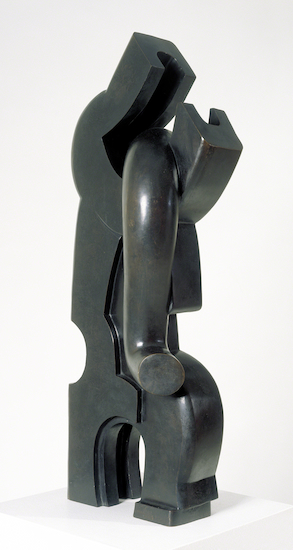 |
| John B.W. Storrs, Abstract Figure, ca. 1932, bronze, 84.77 x 24.76 x 33 cm Buffalo AKG Art Museum, Buffalo, NY, © 2026 Artist or Estate of Artist (AK-1066)
|
During the 1920s, Storrs work gradually took on aspects of Art Deco within the Cubist idiom. A 1923 exhibition of his works at the Société Anonyme in New York established him as a member of the international avant garde, rather than an American realist, the dominant trend at the time in American sculpture.
Storrs' interest in Art Deco gradually evolved into an appreciation for machine imagery. Modern machinery was one of the main inspirations behind Art Deco. The interest transformed his sculptures in to totally abstract forms that vaguely referenced the human figure, with more of an architectonic (architecture-like), columnar form. Abstract Figure is a good example of how some of Storrs' works of the 1930s could have doubled as piers (building support) in a modern office building.
Background
At the turn of the 1900s in the US, sculpture was under the stranglehold of academic classicism. This was particularly true after the 1893 Chicago World's Columbian Exposition which was a virtual extravaganza of Beaux-Arts Classicism and every other imaginable academic revival style. This entrenched classicist realism endured in the work of nearly all American sculptors up until World War II (1939-1945).
Despite that, there were some progressive tendencies in sculpture inspired by European modernism, brought to America by expatriates who had studied abroad, and by European artists coming to America. There were brief experiments with the romanticism of Rodin, the Art Deco formal experiment based on Cubism, Expressionism, Futurism and Dada. Some progressive artists who defied the academic trend pursued personal, lyrical forms of abstraction.
John Bradley Walker Storrs was born and raised in Chicago, the son of an architect. In 1905 he went to Berlin to study singing, but soon decided to be a sculptor. Upon returning to America, he studied under academic realist sculptor Lorado Taft (1860-1936) and the School of the Art Institute of Chicago. He subsequently studied under the academic realist Bela Pratt (1867-1917) at the School of the Museum of Fine Arts in Boston. By 1911 he lived in Paris and was a student of Auguste Rodin (1840-1917) until the latter's death.
During his first period in France, Storrs met the Cubist sculptor Jacques Lipchitz (1891-1973). After 1914 he divided his time between Paris and the US. It was during this time that his work transformed from basically realist to one obviously influenced by Cubism and Futurism. After World War I (1914-1918) he divided his time between the US and France until 1939, when he remained in France for the rest of his life.

Comments