
Artist Birthday: Jean Arp (1886-1966 France)
Jean Arp was truly an artist who was in the right place at the right time when it came to helping discover the Dada art movement during World War I (1914-1918). His truly imaginative and unique works laid the groundwork for Surrealism.
Artist Birthday for 16 September: Jean Arp (1886-1966 France)
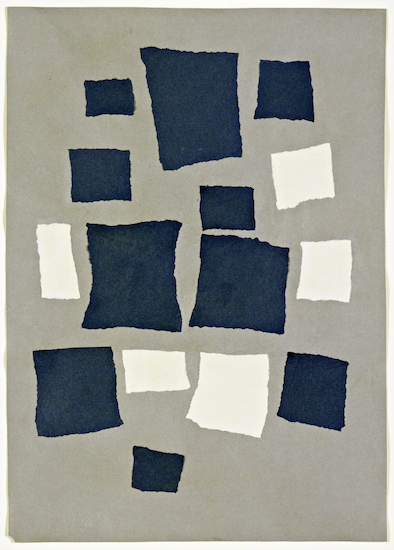 |
| Jean Arp, Collage with Squares Arranged According to the Laws of Chance, 1916-1917, torn-and-pasted paper on blue-gray paper, 48.5 x 34.6 cm, The Museum of Modern Art, New York, (c) 2026 Artists Rights Society (ARS), New York (MOMA-P1606ajars)
|
Arp struggled a long time before he hit his stride with complete abstraction. He at first experimented with works based on Cubism's destruction of space into geometric planes and cubes. Allowing simple and spontaneous elements with full freedom, Arp came to the conclusion that the dissolution of traditional pictorial space was a result of pure chance. Between 1916 and 1917 he produced a series of torn paper collages arranged in vaguely geometric configurations on a blank background. One story is that he tore up a drawing he did not like and after throwing it down was pleased by the chance arrangement.
Background
After World War I (1914-1918) in Europe, many artists sought new forms of expression that rejected the physical world of "logic" and "reason" that they felt was responsible for the madness of that war. These artists believed that an artist's imagination and dreams were as important or more important than what most people considered reality.
This was in tune with German philosopher Friedrich Nietzsche's (1844-1900) philosophy about the lyric significance of everyday objects and the superiority of a free spirit. The Dada movement of ca. 1919-1922 sought to redefine what could be considered valid subject matter in art. The irrational was preferred to the logical.
By 1922, some artists accused Dada of becoming institutionalized / codified. Surrealism had its beginnings in these rebels. According to André Breton (1896-1976) who wrote the Surrealist manifesto in 1924, the Surrealism movement was pure "psychic automatism", art created by intuition rather than by conscious thought. Surrealists created art based on fantasy, dreams, and random thoughts, all unfettered by any traditional aesthetics, reason, or morals.
Born in Strasbourg, France, Jean Arp studied there between 1900 and 1908 at the School of Arts and Crafts, subsequently the Weimar Academy of Art, and the Academy Julian in Paris. Dissatisfied with academic curriculum, he moved to Switzerland where he established the short-lived Modernist Confederation. The organization came to the attention of Vasili Kandinsky (1866-1944). The Swiss landscape made an impression on him, for his later abstractions were based on organic and natural shapes. In Switzerland he also met the fantasy-abstractionist Paul Klee (1879-1940).
In 1911 Arp returned to Germany where, drawn to Kandinsky's circle, he became a member of the German Expressionist group The Blue Rider (Der Blaue Reiter). In 1914 he was back in Paris, exposed to all the modernist experiments of Picasso, Modigliani and Delaunay.
During World War I Arp lived in Switzerland and was a member of the ground-breaking Zurich Dada group centered at the Cabaret Voltaire. Because Arp destroyed all of his pre-war paintings, the development of his mature style is a mystery. He experimented briefly with geometric abstraction based on Cubism, and by 1915, he was producing drawings featuring shapes based in nature such as leaves, insects and animals.
Correlations to Davis programs: Explorations in Art Kindergarten 2E, Unit 1 lesson 5; Discovering Art History 4E, lesson 14.4; AP Art History, Content Area 4 -- Later Europe and Americas

Comments