Artist Birthday: Ivan Kudryashov (1896-1972 Russia)
Ivan Kudryashov was active in the exciting period of Russian modernism that blossomed right before the Russian Revolution (1917), and continued into the 1920s, the last decade before avant-garde art was stamped out by the Soviet regime.
Artist Birthday for 2 October: Ivan Kudryashov (1896-1972 Russia)
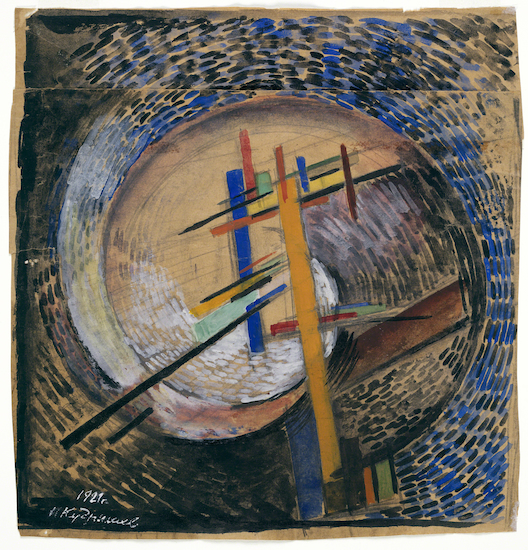 |
| Ivan Kudryashov, Suprematist Composition, 1921, pencil, watercolor and gouache on paper, 23.5 x 22.2 cm The Museum of Modern Art, New York, © 2026 Artist or Estate of Artist (MOMA-P3266)
|
Kudryashov's paintings often have a sense of dynamism because of the combination of light and line. Often, as in this Suprematist Composition, the lines and shapes curve in place or actually swirl around sort of central focal point, in this painting the confluence of line/shapes in the center. Here Kudryashov's encounter with Rayonism is visible in the swirling, pulsing symbols of force in the Pointillism-like dots of cobalt blue that emanate from the center. The swirling, star-system like composition is a prime example of Kudryashov's visualization of Tsiolkovskii's ideas about "Cosmism", which Kudryashov eventually termed many of his paintings.
Background
Starting in the 1880s, the foundation of groups such as the "World of Art" began a debate among Russian artists on whether Russia should modernize in art based on Western Europe or on indigenous, distinctly Russian avenues. After the "World of Art" journal came out in 1898, other avant-garde art publications followed.
The group Jack of Diamonds formed (1910) as a vehicle by which Russian modernists could form exhibitions of their works combined with European modernists. The artists’ group “Donkey's Tail” (founded 1911) exhibited purely Russian modernists. Russian artists, however, more and more looked to western European modernism, such as Post-Impressionism, Neo-Impressionism, Expressionism and Cubism for examples of experimental art. These artists were interested in adapting the underlying philosophies of these movements and putting a distinctly Russian imprint on them.
Suprematism was a Russian modernist movement developed by Kazimir Malevich (1878-1935) of the early 1900s that emphasized the “supremacy of pure feeling.” It rejected the illusions of representational painting in favor of simple geometric shapes as symbols of the ideal. It was the most radical liberation of Western painting from any reflection or imitation of the physical world, a purely spiritual expression.
Ivan Kudryashov was born in the Kaluga Oblast near Moscow. He is one of the lesser known adherents to the Suprematist movement, who added his own personal vision to the style. He was a painter, graphic artist, set designer, and teacher. From 1913 to 1917 he attended the Moscow Institute of Painting, Sculpture and Architecture where he received an academic painting training.
From 1918 to 1919 he studied at the Moscow Free Workshops under Suprematism founder Kazimir Malevich. He fell under the influence of the groundbreaking astronautics ideas of Konstantin Tsiolkovskii (1857-1935) who described his theories as "Cosmism". Cosmism is centered on the of the universe's inherent sentience and the possibility of humanity's cosmic destiny, including immortality and space colonization, achieved through technological advancements and scientific understanding. Kudryashov came to call many of his paintings Cosmism.
From 1921 on Kudryashov worked as a set designer. In 1922 he exhibited in the "First Russian Art Exhibition" in Berlin. Between 1925 and 1928 his abstract works were exhibited with the artists' group exhibitions of the OST group, which he helped co-found. After 1928 he stopped exhibiting in the Soviet Union. In 1932 the Soviet dictator Stalin dissolved all independent artist groups and established the Artists Union of the USSR, effectively making Socialist Realism the office Soviet art style. In the 1960s he did variations on his abstract compositions in printmaking. In 1970 there was a personal exhibition of Kudryashov paintings in Paris.

Comments