
Artist Birthday: Frank Stella (1936-2024 US)
The paintings, sculptures and installations of Frank Stella have defied a single stylistic designation throughout his career. He among the many artists who established their mature artistic vision in a period dominated by Abstract Expressionism. He was also an artist who rebelled against the strictures of that style, and established a unique body of work.
Artist Birthday for 12 May: Frank Stella (1936-2024 US)
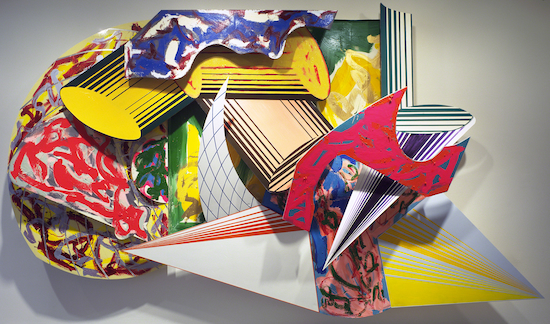 |
| Frank Stella, The Moon, The Thieves, and the Guards, 1984, synthetic polymer paint, oil, urethane enamel, fluorescent alkyd, and printing ink on canvas, etched magnesium, aluminum, and fiberglass, 293.3 x 491.1 x61 cm The Museum of Modern Art, New York, © 2026 Frank Stella / Artists Rights Society (ARS), New York (MOMA-S0167slars) |
Stella applied his trademark brilliant color to three-dimensional painted reliefs that questioned the traditional categorization of "painting" and "sculpture." Not only did works such as Giufa... challenge the restraint typical of Minimalism, Stella introduced into this work a painterliness and jagged shapes that were similar to the aspects of Abstract Expressionism that he had earlier rejected. The technique was collage-like in form and attained continuing complexity through the 1970s. By the 1980s, Stella had abandoned any pretension of these pieces to painting and produced monumental, painted, complex sculpture.
Background
A number of exhibitions held in the 1960s highlighted changes occurring in American abstract painting. Abstract Imagism, Systemic Painting, and, the most enduring, Color Field painting, were terms used to identify this new trend in abstraction. The broader term of post-painterly abstraction was applied to the work of this group of painters to differentiate the trend from the action painting of Abstract Expressionism. The exhibitions illustrated just how many younger painters were trying to break with what they felt was the tyranny of Abstract Expressionism’s emphasis on individual, personally charged brush stroke.
While artists used many different approaches, the emphasis was on pure abstract painting, with a subordination of brush stroke and paint texture. One of the logical end results of color field painting was a movement which took the emphasis on flat surface rather than illusion and the idea of the artwork as an object to its greatest extreme of reduction: Minimalism. Frank Stella's painting -- although the artist declines to associate it with a particular movement -- could be seen as a crossover between Color Field and Minimalism.
Inevitable in all movements that focused on one form of rebellion against prevailing trends, Minimalism had tapped out in outrageous ingenuity by the early 1970s. Many artists were not satisfied with producing art that was concerned only with formal elements. The re-emergence of artists who explored gesture, shape and texture in the 1970s were put under the blanket term Post-Minimalism. However, Post-Minimalism, like many art historical convenience terms, does not sum up a single style or subject matter. Rather it alludes to artists who wished to introduce the personality of the artist back into the artwork, divorced from social or economic comment. This linked Post-Minimalism to the Conceptualist movement.
Born in Massachusetts, Frank Stella received art training at the Phillips Academy in Andover and at Princeton University. He was initially drawn to the modernism of Abstract Expressionism because of its emphasis on process rather than representation. The Abstract Expressionist's work to whom he was most drawn was that of Barnett Newman (1905-1970), whose clean planes of unmodulated color contrasting with precisely place lines of contrasting color expressed the simplicity and lack of reference for which he was looking in his own painting.
An abstractionist from the beginning, he developed his own style of reduction in his early black paintings which featured narrow bands of black pigment separated by unpainted lines of canvas. The painting not only represented the primacy of the two-dimensional surface, but went beyond to posit that artworks -- unlike the Abstract Expressionists believed -- should not exist as an autonomous work based on the personal energies of the artist, but rather should establish an interaction with the viewer, in Stella's case, optically.
After the black paintings Stella introduced some color with metallic pigments of copper and aluminum. After 1960 Stella introduced vibrant color into his compositions. His works of the 1960s consisted of parallel lines of alternating, brilliant color. His works, although optically exciting, have largely been associated with Minimalism rather than Op Art. By the mid-1970s, Stella was seeking other forms of expression, partially because he was among the artists who believed Minimalism had addressed whatever formal and theoretical issues it had confronted.
Correlation to a Davis program: Experience Painting, Chapter 9

Comments