
Artist Birthday: Francis Frith (1822-1898 Britain)
Tourists were the main consumers of photographic views of far-off places during the early days of photography. The camera was considered the best chance to record exotic far-off places “beyond anything…the most accomplished artist could transfer to his canvas” in the words of pioneering travel photographer Francis Frith.
Artist Birthday for 7 October: Francis Frith (1822-1898 Britain)
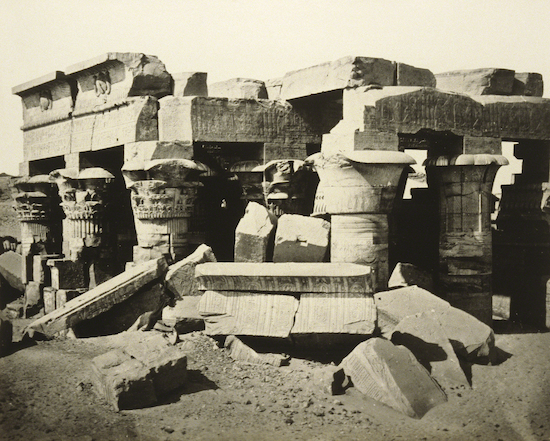
Francis Frith, Temple Ruins in Kom Ombo, Aswan, Egypt, ca. 1858 from the series Sinai and Palestine,
albumen print on paper from wet collodion negative, 39.5 x 49 cm Image © 2026 Cleveland Museum of Art (CL-406)
Between 1856 and 1860 Frith made three trips to the Near East, taking large-format cameras for the wet collodion process. In addition to photographing, he wrote voluminously about the difficulty of the project. The cumbersome wet collodion process was fraught with difficulties. Sometimes in the desert heat, the collodion solution would boil when it hit the glass plate. There was also the problem of keeping bugs and sand off of the sticky undeveloped glass plates. Frith also complained how difficult it was to compose scenes of ruins and natural phenomena.
Despite those complaints, Frith proved himself to be a master at creating balanced compositions. This image is from the series Egypt and Palastine Photographed and Described. Frith arranged the camera to capture equal areas of lights and darks. He undoubtedly had classical landscape painting in mind when he arranged his photographs. Like all travel photographs of the period, it is a straightforward, realistic documentation of a scenic place. The photographs of Egypt were published simultaneously in New York and London
Background
The desire to accurately depict buildings and landscapes had led to the invention of the camera obscura. Even with the device, accuracy was hard to achieve, and that led William Henry Fox Talbot (1800-1877) and others to experiment for a more exacting way to replicate reflected images.
Early in the 1800s, photographers used the Daguerreotype and calotype processes to provide views of nature that would bring new data to botanists and other scientists; and new understanding about the relationships between nature and built environments.
Travel photography became a new genre. Few but the wealthy could afford to travel to foreign places during the 1800s. The middle class was eager to have views of exotic lands to place in their homes. They relied on accurate depictions of far-away places in paintings and prints. Photographers throughout Europe in the 1850s and 1860s and in the United States in the late 1860s met the demand for travel photographs.
Landscape photography of the Near East and Far East was wildly popular in Europe during the 1850s and 1860s. Some thirty to forty European and American photographers were drawn to the Near East before the 1880s. Francis Frith was one of them.
Frith was the owner of a printing company. Frith began taking photographs around 1850. When Frith returned to England in 1860 from the Middle East, he embarked on another colossal project: photographing every town and point of historic interest in England. He managed to photograph 7,000. By that time, Frith no longer worked alone and employed twelve photographers. They were all trained in the same meticulous objectivity that was the hallmark of Frith’s style.
The success of sales of his Egypt photos may have made Frith realize the commercial possibilities in publishing photographs. He established Francis Frith and Company in 1860. By the 1880s his archive contained 330,000 negatives, including both his views of the Near East and English towns. He published his photographs in albums, and as postcards, which were very popular as souvenirs, but not legalized for the mail until 1898.

Comments