Artist Birthday: Eero Saarinen (1910-1962 US, born Finland)
Having flown into Dulles Airport two times in my life, once at 9 years old, and once in my 30s, I can honestly say it is one of the most stunningly beautiful airports I’ve ever traveled through. Like much of the architecture in the 1960s, Dulles is Saarinen’s personal interpretation of the International Style, a wonder of cantilevering and glass curtain walls that is an absolute pleasure to be inside of.
Artist Birthday for 20 August: Eero Saarinen (1910-1962 US, born Finland)
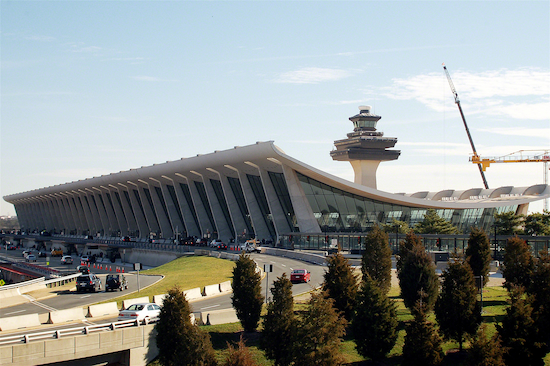 |
| Eero Saarinen, Dulles Airport, Chantilly, Virginia, 1960-1961, 1990s Image: © 2026 Davis Art Images (8s-14761) |
Saarinen was able to produce expressive, romantic architecture in two airport designs, the TWA Terminal at Kennedy Airport in New York, and Dulles Airport in Chantilly, VA. Dulles, completed after his death, presents a unity of design and appreciation for the problem of ever-increasing air travel in his terminal.
The flaring roof that seems to float on the ferro-concrete pylons has a lightness that imitates the idea of flying, while the lightness is accentuated with the glass-sheathed walls. The pylons and curving roof are a novel updating of the ancient post-and-lintel system.
Saarinen took into account circulation by designing mobile passenger lounges to move people directly to a plane. Because Saarinen had foreseen expansion as a probability, his original plans included enlarging the terminal by 97 meters (320 feet) on both ends of the terminal without disrupting the basic original form. The expansion (not seen here) was completed in the 1990s.
Background
While modern architecture of the second half of the 1900s in America was dominated by the International Style and the school of Frank Lloyd Wright, there were other avenues that were explored. The booming economies in the West after World War II (1939-1945) led to a boom in building on an unprecedented scale in the 1950s and 1960s.
This boom encouraged some architects to look beyond the rectilinear nature of the International Style, and use the new structural systems such as ferro-concrete in new and innovative ways. Personal expression trumped the visual expression of function in some architects' designs. With buildings extending beyond the geometric limitations of the International Style, some architecture of this period presents a dramatic, sculptural quality.
Eero Saarinen is an example of an architect who was once an advocate of the International Style, but who branched out to assert a more personal style. Saarinen's father Eliel (died 1950) was a leading Finnish architect. Eero was born in Finland and his family moved to the US in 1923.
After initially studying sculpture, he studied architecture at Yale until 1934. He eventually joined his father's architecture firm in Michigan in 1936. He also took a teaching position at the Cranbrook Academy, a school in Bloomfield Hills, MI, that was modeled on the Bauhaus in stressing the integration of all arts and architecture with each other.
Eero Saarinen's early architectural designs were firmly rooted in the International Style. This began to shift in the 1940s after he met architect and furniture designer Charles Eames (1907-1978). With Eames Saarinen began designing furniture in organic rather than geometric forms. In 1948 he won a competition to design the Jefferson National Expansion Monument ("Gateway Arch") in Saint Louis. Saarinen designed a monumental arch for the city that was once the gateway to westward expansion by pioneers. It was far more a romantic expression of an ideal rather than logic or function.
Correlations to Davis programs: Explorations in Art 2E, grade 2, lesson 6.4; The Visual Experience 3E, lesson 11.5

Comments