Artist Birthday: Doug LaFortune (born 1953, Coast Salish First Nations, Bellingham, WA)
Like the many other indigenous cultures of the US, the Coast Salish and other Northwest Coast cultures possess a rich, multifaceted artistic culture. Northwest Coast indigenous artists such as sculptor Doug LaFortune create some of the most renowned subjects in native arts – the totem.
Artist Birthday for 25 August: Doug LaFortune (born 1953, Coast Salish First Nations, Bellingham, WA)
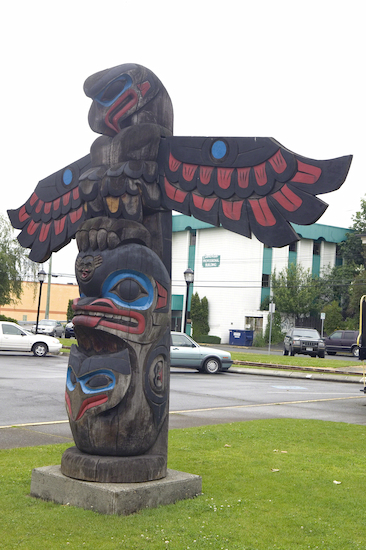 |
| Doug LaFortune, The Feast totem, 1987, restored 2016, painted cedar, height: 3.75 meters (12.25 feet) Image: Dr Ron Wiedenhoeft / Saskia Ltd., © 2026 Doug LaFortune (PUD-0218) |
LaFortune relates that The Feast was based on a local Quw’utsun’ legend -- The Quw’utsun’ people called upon the Thunderbird to help them. The Killer Whale was eating all the salmon in Cowichan Bay and the salmon were not getting up the river. Thunderbird helped by taking the Killer Whale out of the bay and putting it on top of Mount Tzouhalem, the mountain beside the bay, where Thunderbird ate him. LaFortune transformed the thunderbird into an eagle.
Background
Archeological evidence reveals that the Coast Salish people may have inhabited the region of British Columbia, Oregon and Washington as early as 9000 BCE. Throughout their long history, the Coast Salish cultures have relied primarily on fishing as the backbone of their survival. Although the Coast Salish language and dialects include dozens of bands that are interconnected and interrelated, they are all distinct.
The Coast Salish bands cover roughly 1500 miles of coast between southeast Alaska, Canada, and Washington and Oregon. The designation "Coast Salish" was coined by Anglo linguists to distinguish the many bands of Salish-speaking people. The clans of the Salish include Chemainus also the Penelakut, Hallalt, Cowichan and Seclameen bands.
Totem's among the Northwest Coast indigenous peoples are made to honor ancestors or clans, commemorate an encounter with a supernatural being, or record clan history. Only the clan for which the totem was carved and the artist would know the meaning of the totem. Traditionally, they are displayed before a clan's main dwelling. They were emblems of honor, not objects of worship.
Doug LaFortune was born in Bellingham, WA, and is a member of the Tsawout Band of Coast Salish. He studied Fine Arts in college in Victoria, BC. After meeting world-renowned Coast Salish sculptor Simon Charlie (1919-2005), LaFortune's aspiration to be an artist was rekindled. He subsequently studied under Charlie, becoming a master at carving totems, masks, feast dishes and small figures.
Correlation to Davis program: A Global Pursuit 2E, lesson 6.1

Comments