Artist Birthday: Amanda Means (born 1950 US)
Just as artists in many different media have, in the 21st century, discovered even more novel ways to use these media in personal expression, so too have photographers, who many decades ago abandoned the notion that photography was only a valuable tool for documentation. Amanda Means has explored numerous types of cameraless photography.
Artist Birthday for 9 June: Amanda Means (born 1950 US)
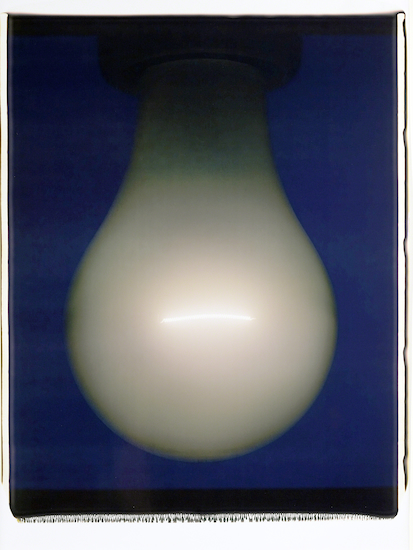 |
| Amanda Means, Light Bulb 0050C, 2001, diffusion transfer print on paper Buffalo AKG Art Museum, Buffalo, NY, © 2026 Amanda Means (AK-1715)
|
Means has explored the limits of the photography medium, while working with everyday objects such as light bulbs, plants and water glasses. An early series of light bulb images were executed in black-and-white. By 2000 she was exploring the light bulb series in color, in a variety of exposures. For Means, light bulbs are representative of the duality of the human experience balanced between the natural and built environments.
The artist uses objects such as light bulbs as photographic negatives rather than film. She places the light bulb on a piece of glass in the photographic enlarger. The enlarger light passes through the light bulb making it appear that it is glowing. The effect is that the bulb seems to be emanating its own light. Traditional photographic techniques exploit reflected light in both camera and darkroom. Means' techniques avoids light reflection completely.
Background
As early as 1839, the year the Daguerreotype photograph announced the birth of photography, the French Realist history painter Paul Delaroche (1797-1856) had the guts to declare that "painting is dead." This was based on the sudden realization that the camera could duplicate nature precisely in a way no painter could.
Obviously, painting has survived into the 2000s and there is no reason to believe it is going away any time soon. Similarly, in the 1990s, many art critics declared that photography was dead. This notion was predicated on the development of computer imaging, digital technology, and programs such as Photoshop. Photography has proven just as durable as painting.
Photography relies on the ability to fix shadows on a light-sensitive surface. In the 21st century, many photographers experiment with camera-less photography. Some of the earliest experiments in photography in the 1830s were produced without cameras. They were created of exposing light-sensitive paper to sunlight with objects between the sun and the paper.
There are three types of traditional cameraless photographic processes that have been around since that time -- 1) the photogram, made by placing objects in direct contact with photo-sensitive paper and exposing both to light; 2) the chemigram, made by directly manipulating the surface of photographic paper, often with other media added; and luminogram, a variation on the photogram in which objects are placed between the light source and paper without touching.
The photographic work of Amanda Means is largely done without a camera. Raised in Marion, (upstate) New York, she grew up in a farming community. Quiet, starlit nights in the country and her subsequent move to Manhattan have inspired her fascination with not only light, but exploring contrasts of natural and man-made and combinations thereof. She acquired a BA from Cornell University in 1969, and an MFA at SUNY, Buffalo in 1978. Early influences on her photography include the light-charged projects of James Turrell (born 1943) and the light-infused images of Yosemite Valley by Carlton Watkins (1829-1916).
Initially, Means photographed tangled underbrush in closeup and printed the exposures in her Manhattan darkroom. The tangled weeds -- a natural element -- symbolized the chaotic environment she felt surrounded her in New York. From there she progressed to photographing flowers and leaves without a camera. Ironically, Means worked as a master black-and-white photographic printer for artists such as Robert Mapplethorpe (1946-1989) and Roni Horn (born 1955), and for the Smithsonian Institution. However, the majority of her current work is done without a camera.
Correlations to Davis programs: Focus on Photography 2E, Unit 8 Close-Ups; Davis Collections -- Women Artists

Comments