A Barber's Bowl Bouquet for Spring
When visiting a museum collection, I have always marveled at objects meant for medical, military or some other non-aesthetic purpose are, just the same, beautifully decorated. This happened recently when we went to the Worcester Art Museum to see the newly installed Higgins Collection of arms and armor, where muskets, swords and daggers are decorated with beautiful floral inlay in ivory or metal. It does not surprise me, then, when seeing a barber’s bowl – which served not only for shaving but also other grisly tasks – decorated with a lovely still life.
A Barber's Bowl Bouquet for Spring
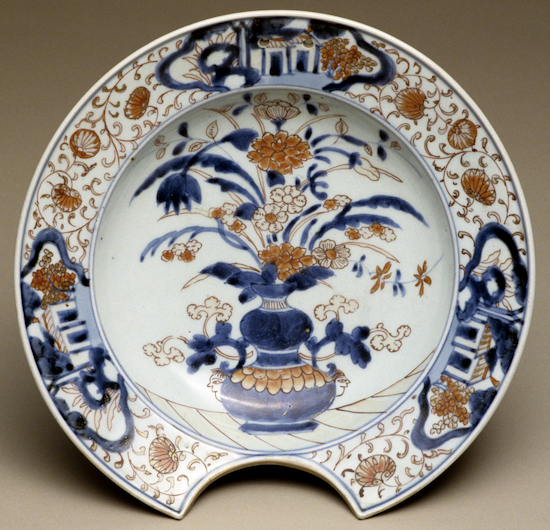 |
| Japan, Barber’s Bowl, 1700s, Imari ware porcelain, width: 26.7 cm (10 1/2”) © 2026 Philadelphia Museum of Art (PMA-2273)
|
Imari is one of the Arita wares that were a popular export item from Japan to the West. Many Imari porcelains feature an underglaze deep blue and red decoration that was distinctive. This particular type of Imari is characterized by the domination of the blue-and-red pattern over the white of the porcelain.
Dutch and English porcelains often show the influence of Imari ware, particularly the English Caughley (1772-1799) and Churchill (1795 to present) factories. Many Imari wares were made exclusively for export, decorated in what they believed was Western taste. The center of this bowl shows peonies (botan), prunus (ume), chrysanthemums (kiku), and hydrangeas (ajisai) in a vase.
From the Middle Ages to early 1800s, barbers were known as "barber-surgeons". This barber’s bowl was produced to accommodate the medieval conviction in Europe and America that occasional (via the wrist) bleeding (bloodletting, or phlebotomy) kept a person healthy. The notch in this bowl – with its western-inspired still life – was where the patient placed his neck either to be shaved, or his wrist to be sliced for treatment. The red-and-white barber's pole -- still seen today -- is thought to have symbolized the barber's "surgery" skills at bloodletting, red for blood and white for bandage.
Background
The Edo (or Tokugawa) Period (1615-1868) was the last period of traditional Japan. It was a time of peace, political stability and economic growth under the military dictatorship (shogunate) founded by Tokugawa Ieyasu (1543-1616). In the 1630s there was a complete ban on Christianity, an expulsion of all foreigners except a few Dutch and Chinese traders in Nagasaki, and, from 1633, a ban on foreign travel by Japanese. The roughly 250 years of peace led to an expansion of the Japanese economy, particularly in commerce and manufacturing, which led to the development of large urban centers.
The late Momoyama (1573-1615) and early Edo periods witnessed an increased demand for tea-ceremony wares. Individual artists’ names became more prominent from the 1600s on, with the concept of the artist-ceramicist paralleled the trend in painting of the evolution of ceramic schools of genealogical consequence.
The new porcelain technique was of extraordinary importance to the development of Edo period ceramics. The discovery of kaolin (porcelain clay) in Bizen province, Kyushu, combined with imported Chinese techniques via immigrant Korean ceramic artists led to a flourishing in porcelain production.
The most extensive network of kilns for porcelain production was in the Arita region of Bizen. Many of these wares, by the third quarter of the 1600s, were exported to Europe and ended up in royal collections throughout the West, where Arita wares heavily influenced fledgling European porcelain makers starting in the 1700s.
Correlations to Davis programs: Explorations in Art 2E grade 2, lesson 3.9; Explorations in Art 2E grade 5, lesson 5.9; Experience Clay 3E page 70

Comments