
18 June is National Go Fishing Day: Art by Eastman Johnson (1824-1906 US)
The genre paintings of Eastman Johnson reveal the prevalence of an unvarnished realism in American art in the first half of the 1800s. His work mirrors the interest of another 1800s American realist Winslow Homer (1836-1910). While National Go Fishing Day was never declared by Congress or the president, it grew in popularity during the 1950s when fishing enthusiasts and organizations promoted sustainability, wildlife management, and appreciation of aquatic ecosystems.
June 18 is National Go Fishing Day: Art by Eastman Johnson (1824-1906 US)
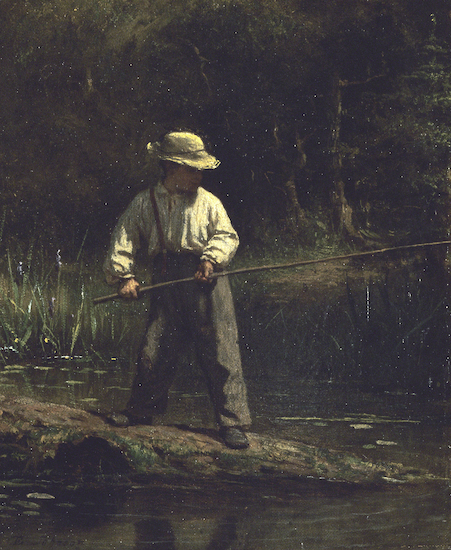 |
| Eastman Johnson, Boy Fishing, 1860s, oil on canvas, 23.5 x 19 cm © 2026 Cleveland Museum of Art (CL-872)
|
The work of most American realists like Johnson differed from Realism in France, because it was injected with a strong sentimentality and national pride. Johnson explored themes of national life with his humble interior scenes and larger rural tableaux, each picture usually the result of careful study through numerous drawings and oil sketches. The strong contrasts in dark and light, meticulous detail and attention to symbolism all reveal the influence of Dutch Baroque genre painting.
Paintings such as this became very popular during and after the Civil War (1860-1865). Such bucolic scenes harked back to the "good old days" (or so it was perceived) of before the war. Johnson's meticulous rendering of the sunlit parts of the boy recall the work of Winslow Homer (1836-1910), whose observations of sunlight on subjects were rendered in a traditional academic palette and painted in the studio.
Background
Through the first decade of the 1800s, portraiture was the dominant subject matter in American painting. With victory in both the Revolution and War of 1812, American tastes in art patronage expanded to include subject matter that reflected the affluence and beauty of their new country. Landscapes, still life and genre all rose in popularity with middle class art patrons.
Genre painting -- the depiction of everyday life and labor -- flowered after 1820s. American genre painting reflected the diversity of its audience. They sometimes rendered an idealized version of the US as a nation without conflicts, class divisions or industrial disruptions. Genre used realism to render public or private opinions, especially the American vision of the United States as the first true democracy since ancient Greece.
Eastman Johnson, born in Maine, because of his interest in drawing, worked for a year in a lithography shop in Boston. In 1842 he began making and selling charcoal portraits at cheap prices. He drew portraits in Cambridge, Newport and in 1845 moved to Washington, DC, where he attracted the patronage of some famous people. After receiving a sizeable portrait commission from Henry Wadsworth Longfellow, he stayed in Boston for 3 years starting in 1846.
In 1848 Johnson completed his first oil painting, a portrait of his grandmother. In 1849 he went to Europe to improve his painting, first to the academy in Düsseldorf, Germany where he gained an academic background in painting techniques, briefly to France and Italy, and then to The Hague, Netherlands.
Johnson gleaned his greatest influence there in his three odd years in the Netherlands. He studied the work of 1600s Baroque genre and history painters, particularly Rembrandt. He returned to the US in 1855, determined to paint American subjects in a style reflecting the formal elements of Dutch Baroque painting.
During the Civil War (1860-1865), Johnson followed the Union army, making sketches for genre painting subjects. After the war, and for the next twenty years, he concentrated on intimate genre scenes in New England, primarily around Kennebunk where his family lived. He found that his sentimental genre scenes were much in favor after the horrors of the war, as Americans turned nostalgic for those bucolic, “unspoiled” days before the war with scenes of simple American pleasures and innocence.

Comments