I encourage my students to share their ideas, ask questions, and become observational learners. It is natural for them to want to learn more about who we are as people. The question becomes how much am I willing to share? How can I turn these stories and experiences into words of wisdom? In what ways can I connect on a deeper level? And how can I guide them to become better listeners, supporters, and advocates for their peers?
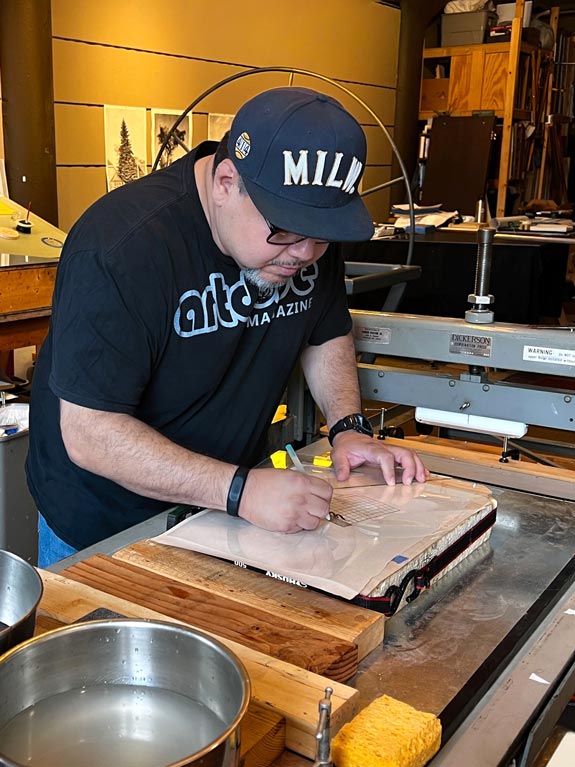
Frank learning how to create a lithography stone at the Todd Mrozinksi Studio in Milwaukee, Wisconsin.
Practicing vulnerability is difficult. How much of ourselves do we want to share with the world? What do we decide to keep private and make public? I know there is a fine line that separates the two, but for me, they tend to blur. Perhaps this happens because of the multiple roles that I engage in as an art educator, artist, writer, publisher, editor-in-chief, and being me. As a human, I want others to feel comfortable, included, and appreciated.
Keeping It Real
The process of understanding begins with us. This reminds me of a time when a former student, Anabelle, said to me, “Mr. J, can I tell you something? You hear, but you do not listen.” For most, this could easily be a sign of disrespect. I did not see it this way. She was right. Sometimes, I do acknowledge students by nodding with no direct eye contact as I am working. How would I feel if I were talking to a colleague or a parent and experienced the same response as Anabelle? This theme of understanding is the basis for who we can become—better listeners, supporters, and advocates for our students and profession.
In This Issue
There are many examples of how art educators respond to and connect with this theme. Telling stories is a great way to encourage students to open up and share a bit about themselves. Sharing an interest, memory, or experience is not an easy task for most students. With ongoing guidance, time, and space, they can become better communicators and listeners.
In the elementary lesson “Bridging Life with Art: Exploring Understanding through Art-Making,” April Malphurs introduces her students to ways they can connect their lives with the art they create. How can they use art to share ideas, stories, and messages with one another while learning about different cultures and artists, such as Sam Zimmerman, a member of the Grand Portage Band of Chippewa of the Ojibwe Nation on Lake Superior, and exploring his paintings?
In “A New Point of View: Designing for Understanding,” Leigh Anne Hildebrandt explores how Dr. Gholdy Muhammad’s Five Pursuits have shaped her teaching practice. By introducing the pursuit of criticality, she challenges her 2D studio class to use art as a vehicle to design for others by thinking about luxury versus necessity, accessibility versus inclusion, safe spaces and sanctuaries, and environmental impact.
At the high school level, Mayuka Thaïs teaches her students how to draw what they truly see rather than what they think they see in “Magical Portraits.” Direct observational drawing is essential to learning the fundamentals of art-making. Through a variety of demonstrations, the author models what to look for, such as form, value, texture, and details within an object. As they apply what they learn, students turn to themselves as their next subject to draw.
I encourage my students to share their ideas, ask questions, and become observational learners. It is natural for them to want to learn more about who we are as people. The question becomes how much am I willing to share? How can I turn these stories and experiences into words of wisdom? In what ways can I connect on a deeper level? And how can I guide them to become better listeners, supporters, and advocates for their peers?
Art teachers demonstrate how vulnerability, observation, and active listening can help students understand themselves and others. Young students use creative learning strategies to make sense of everyday challenges; elementary students use storytelling to explore different perspectives; middle school students design dream rooms while considering the needs of their communities; and high school students bring individual postcards together in a mural promoting kindness.