You may not always realize the impact you have when you create space for students to tell their stories and share their ideas. Through storytelling, you are teaching art and empowering students to see themselves as artists with something meaningful to say. We hope the articles in this issue inspire you to continue cultivating those voices and exploring why storytelling in art truly matters.
Dr. Leigh Drake in front of a vibrant flower mural by Tamara Vogrin Tara in Virginia Beach’s ViBe Creative District.
In the art room, storytelling is more than a theme; it is a way for students to understand themselves and the world around them. Through imagery, symbolism, and personal narrative, students transform their experiences, ideas, and identities into visual form. Each artwork becomes a voice, offering insight into how students see and interpret their place in society.
As an educator, I aim to create opportunities where storytelling is purposeful and where students are not simply completing projects but constructing meaning through artistic decisions. Whether itʼs through self-portraiture, contemporary references, or conceptual prompts, students are encouraged to consider not just what they are making, but also the story their work communicates to themselves and others.
In this way, the art room becomes a space where narrative thinking develops alongside technical skill, encouraging students to recognize themselves as artists with something to share. When students understand that their work carries voice and meaning, art becomes more than an assignment; it becomes authorship. Storytelling helps students see themselves as artists with ideas and perspectives worth exploring.
In This Issue
Students discover that art is more than creating images; it is an act of making meaning. As they learn to communicate ideas, experiences, and perspectives through visual language, they begin to understand the power of their own voice.
In this issue, you will see how art educators across the nation and at every level are using storytelling to amplify student voice and deepen meaning in the classroom. Storytelling connects art-making with lived experience, whether it’s by helping future educators explore storytelling as a foundation for teaching or by inviting students to share personal and cultural stories.
You will be inspired by classrooms where students use visual narrative to explore identity, reflect on their perspectives, and communicate ideas that matter to them. From projects rooted in personal symbolism to those that connect with broader social themes, these examples highlight how storytelling can transform both the process and purpose of art education.
You may not always realize the impact you have when you create space for students to tell their stories and share their ideas. Through storytelling, you are teaching art and empowering students to see themselves as artists with something meaningful to say. We hope the articles in this issue inspire you to continue cultivating those voices and exploring why storytelling in art truly matters.
I sincerely thank Frank Juárez and SchoolArts magazine for the opportunity to co-edit the 2026 Storytelling issue.
Dr. Leigh Drake is a middle-school art educator at Old Donation School in Virginia Beach, Virginia, where she teaches intellectually gifted and talented students. She has authored more than sixty-five articles and ClipCards for SchoolArts. She currently serves as president-elect of the NAEA Developing Potential and Talent Interest Group and president of the Virginia Art Education Association.
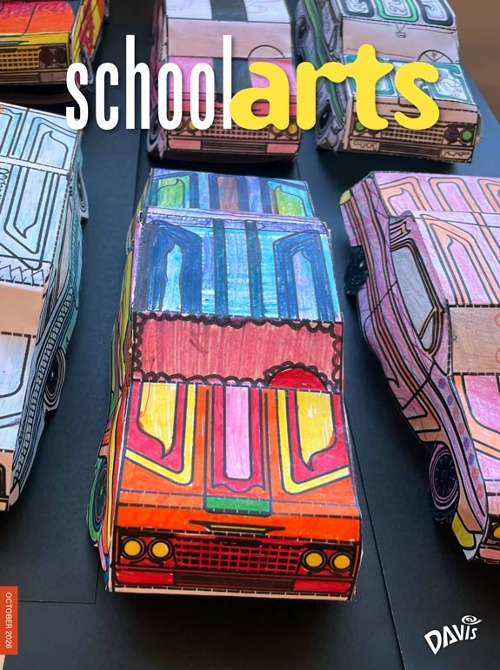
Art teachers use storytelling to build connections and deepen learning. Young students practice foundational art skills while drawing and painting a scene inspired by an Eric Carle classic; elementary students pull from ancient Egyptian hieroglyphs and contemporary art to create visual languages; middle school students navigate personal challenges through cartooning; and high school students celebrate their San Fernando community through personalized 3D lowrider cars.