To help my young artists understand the world around them, I introduce them to the idea of becoming “artivists”—people who use their art to make change. In my elementary art room, I teach them how to reimagine everyday materials and transform them into art with a message. I want students to understand that creativity, even in small ways, can lead to big change. The idea of turning trash into treasure not only teaches creative thinking, but also often connects to the sustainability work we do through our school’s Green Team.
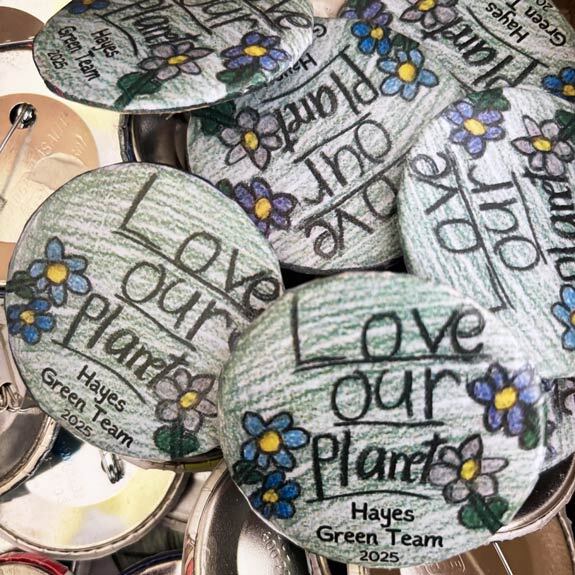
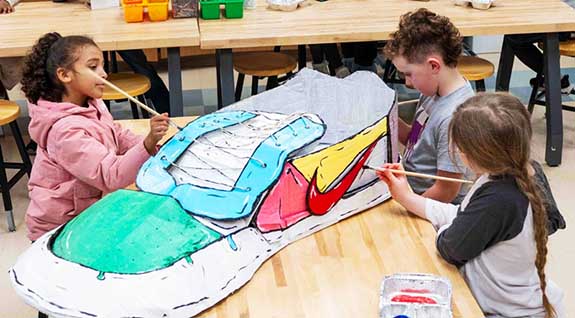
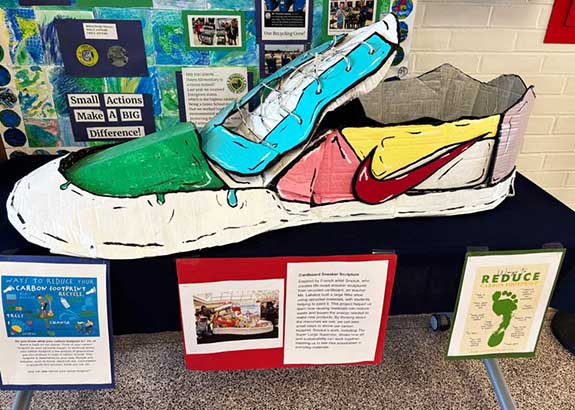
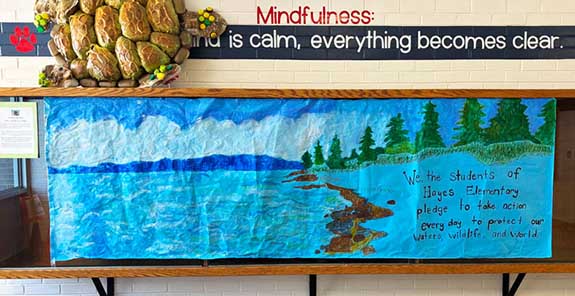
Green Team students repurposed old button bins with their own designs.Through a giant cardboard shoe project, students visualized their carbon footprint.Cardboard Sneaker Sculpture. The artists’ statement reads: “Inspired by French artist Smoluk, who creates life-sized sneaker sculptures from recycled cardboard, art teacher Ms. Lakatos built a large Nike shoe using upcycled materials, with students helping to paint it. This project helped us learn how reusing materials can reduce waste and lessen the energy needed to make new products. By thinking about the resources we use, we can take small steps to shrink our carbon footprint. Smolukʼs work, including The Super Large Superstar, shows how art and sustainability can work together, inspiring us to see new possibilities in everyday materials.”A schoolwide climate pledge banner reading, "We the students of Hayes Elementary pledge to take action every day to protect our waters, wildlife, and world."
Changing the Narrative
Using art to express messages, meaning, and emotion is a powerful form of communication, and one that children can easily relate to. Combining visual art with environmental themes is a natural fit. When I started our first Green Team over ten years ago, one of our earliest projects was a giant sea turtle made from the very things sea turtles often mistake for food: plastic grocery bags, packaging, bottle caps, and cardboard.
The sea turtle still hangs in our school hallway today, and its visual impact helps even my youngest students understand the message at first glance. Over time, the idea of helping the planet grew more meaningful as students began talking about plastic pollution and how human actions affect nature.
The Importance of Upcycling
In my experience, it is customary for art teachers to request consumable materials at the beginning of each school year. A letter sent home asking for donations such as newspaper, egg cartons, and plastic containers saves money and also sparks creativity. Once you’ve dived into a recycling bin a time or two, you start to think differently about the environment.
As I shared that growing awareness with my students, a transformation began. I started to see myself not just as an art teacher, but as an environmental advocate. At the same time, my students began to open up about the things they care about in nature (especially animals), and our shared interests helped build stronger relationships.
Using the very materials they had donated, we explored ways to turn those items into something new and meaningful. I introduced the concept of upcycling and often held Make-It-And-Take-It reward days, where students created something using the materials they donated. These experiences brought a great deal of joy, and I would often hear, “Art is my favorite subject” or “This is the best day ever!”
When we held discussions about how to care for the planet, recycling and upcycling were always among the first ideas students mentioned. That was the beginning of their transformation.
Larger than Life
As our projects continued to grow, young leaders began to emerge. We painted a pledge poster that students could sign after our school discontinued the use of plastic straws. We created Green Team buttons by repurposing old ones with student designs. We used brown paper bags and milk cartons saved from lunch to support lessons about local artists.
Students were always eager to help, whether it was by making labels for a marker recycling collection box or designing plant markers for a local native garden. This helped them connect their artwork to ecosystems in their own community. Our most recent project, a giant cardboard shoe, helped students visualize and better understand their carbon footprint.
These hands-on projects gave students meaningful ways to use their voices and realize their impact within their school and community.
Who We Have Become
Since 2016, our school has been recognized as a Michigan Green School. More recently, we were honored to receive national recognition as the recipient of the U.S. Department of Education Green Ribbon School, and art played a big part in making that happen.
Environmental learning became embedded in our weekly art lessons. Our schoolwide art show, themed Reduce, Reuse, Recycle, Reimagine, brought together everything students had explored. The pride they felt sparked a shift in our entire school community.
The transformation was not just in the art we made, but in how students began to see themselves and their role within their environment.
Conclusion
Over the course of my teaching career, Iʼve learned how easy it can be to use discarded materials in the art room and turn them into something beautiful, meaningful, and full of purpose. Projects like building cardboard kitty forts for our local animal shelter or drawing portraits of adoptable pets show students that their creativity can make a real impact.
These projects don’t stay in the art room. They’ve become part of our school culture and beyond, helping students see themselves as leaders, artists, and problem-solvers within their classroom, school, and community. I used to think my role was only about teaching art. Now I know I’m helping grow a generation of changemakers, one project at a time.
Christine Lakatos is an elementary art educator with more than thirty years of experience and a passion for connecting creativity and sustainability. She has been nominated twice for Teacher of the Year and is a three-time recipient of the PTA Founders Day Award. In addition to teaching art, she leads her school’s Green Team, empowering students through hands-on environmental initiatives. Her work in art and sustainability has been recognized at the local and national levels. Learn more about her projects. CMLakatos1000@Gmail.com
Art teachers and their students learn from, transform, and reimagine the places and spaces around them. Young students connect personal growth to changes in nature, elementary students create abstract faces inspired by Detroit artist Tyree Guyton, middle school students design fantastical digital gardens featuring insects and flora, and high school students use yarn to illustrate cherished childhood memories.