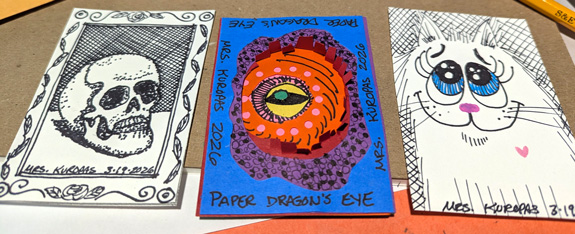
What started as a sub plan evolved into a successful schoolwide collaboration. I had a personal day approaching and decided the artist trading cards would be a fun activity for students to engage in without the pressure of a grade. When I returned the next day, I found out how excited students were by the idea of creating these mini masterpieces. They loved the small size because it was easy to complete, the open-ended format encouraged creative freedom, and there was no pressure of a grade hanging over their heads. The substitute even created her own set of cards.
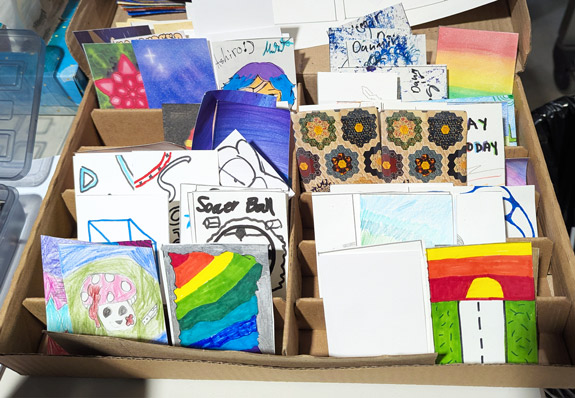
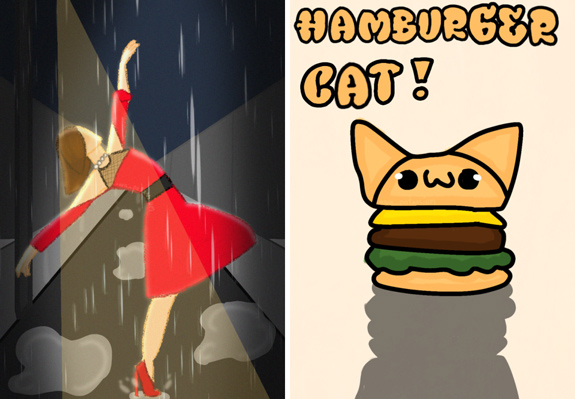
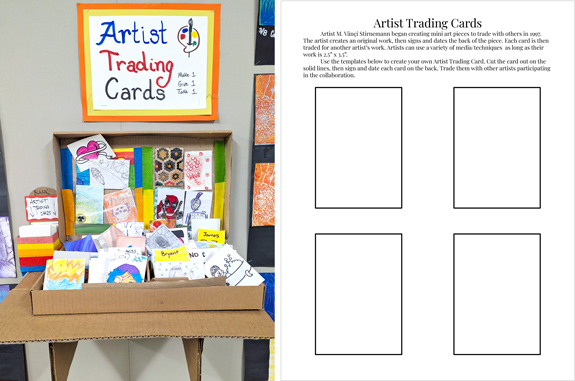
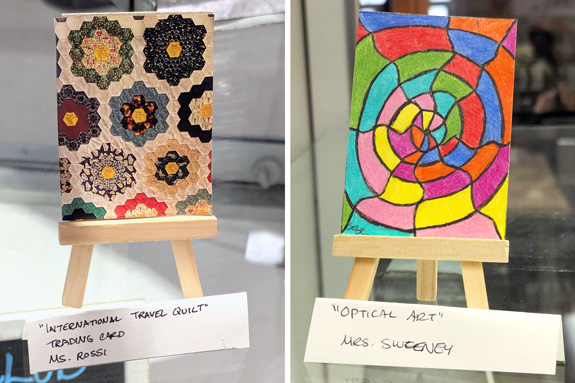
A mix of student- and teacher-created trading cards.Left: Lily E., Untitled, digital art, grade seven. Right: Lily E., Hamburger Cat, digital art.Left: A full look at the Artist Trading Cards center, with instructions to “make one, give one, take one.” Right: Artist Trading Cards template with instructions. Download here.Patty Kuropas (art teacher), Skull, Dragonʼs Eye, and Cat, mixed media.Left: Ms. Rossi (special education teacher), Dancing through Europe, photograph of handmade quilt. Right: Mrs. Sweeney (speech therapist), Optical Art, colored pencil and marker.
What started as a sub plan evolved into a successful schoolwide collaboration. It had been years since I had students create artist trading cards, and to be honest, I didn’t really know the best way to approach them as a graded assignment. The 2½ x 3½" (6 x 9 cm) cards are meant to be open-ended in terms of media and technique, as long as they are the size of a baseball card and traded, not sold. In 1997, Swiss artist M. Vänçi Stirnemann developed this collaborative movement that has evolved into a worldwide art-making trend.
Exploring Joy through Making
I had a personal day approaching and decided the artist trading cards would be a fun activity for students to engage in without the pressure of a grade. When I returned the next day, I found out how excited students were by the idea of creating these mini masterpieces. They loved the small size because it was easy to complete, the open-ended format encouraged creative freedom, and there was no pressure of a grade hanging over their heads. The substitute even created her own set of cards.
Collecting Artist Trading Cards
Next, we needed a place for an exchange. Luckily, I had saved a large box that a colored pencil class pack had come in. The compartments in it were just the right size for the cards. Students cut their cards out from the cardstock template I provided and placed their finished works in the artist trading card box. They could then select other student cards to keep for themselves. Students were displaying artist trading cards in their lockers, in their binder covers, and used them as bookmarks.
After a week or two, I added clear pockets to the open lid of the trading card box by cutting sandwich bags in half and taping them to the lid. This allowed us to showcase some of the cards. Students enjoyed seeing which cards were put in the clear pockets and looked for their favorites.
Beyond the Art Room
It was wonderful to see the art students get excited about the cards, but since I teach at a middle school, not all students were able to participate or gain access to the trading cards. I decided to make this a schoolwide activity. I created an Artist Trading Card Depot across the hall from the art room. I used cardboard scraps to create a box for blank cards that students could take to make their artwork. I also used cardboard scraps to make a shelf for the box to sit on in the hallway. I secured the shelf with pushpins, which I covered with tape to prevent tampering.
Art for Everyone
The next step in making this a schoolwide collaboration was getting the staff to participate. I put the same artist trading card sheet that students started with in each of the staff mailboxes. Administrators, teachers, assistants, custodians, kitchen staff—anyone working at our school with a mailbox received one. I followed up with an email to all of the staff explaining the trading cards and inviting them to participate. I asked them to place their finished cards in my mailbox.
Within a couple of days, I received cards from four teachers. I selected one card from each teacher to display on a mini easel by the art room. The rest of their cards went into the trading box.
After a week, I had a couple more sets of cards from the staff, but nowhere near the participation I had hoped for. I sent out a second email, reminding the staff of the trading card activity and naming each staff member who turned in cards, and said, “These are my new favorite people.” Well, that did it. Suddenly I had cards pouring into my mailbox. I even had a teacher come into my room, put his cards on my desk and say, “I don’t want to be off of your favorite-person list.” Sometimes a little playful motivation helps get the job done!
Reflection
I cannot express the joy I feel when I see a crowd of students, some of whom I’ve never met, depositing and selecting artist trading cards. I even had a non-art student thank me for the opportunity. She couldn’t fit an art class into her schedule, and she really loved this activity. Staff members have been enjoying the compliments they’ve gotten from students about their work and have also been selecting student pieces for themselves. My only regret is not doing this activity sooner.
Patty Kuropas is an art teacher at Kimball Middle School in Elgin, Illinois. PattyMStark@gmail.com
National Standard
Connecting: Synthesize and relate knowledge and personal experiences to make art.
Art teachers get to know students while creating opportunities for connection and community. Early learners build foundational art-making skills as they share stories from their summer; elementary students put their own unique twist on famous artworks; middle-school students create artist trading cards in a project that grows into a schoolwide art-making experience; and high-school students sculpt clay vessels inspired by cherished family heirlooms.