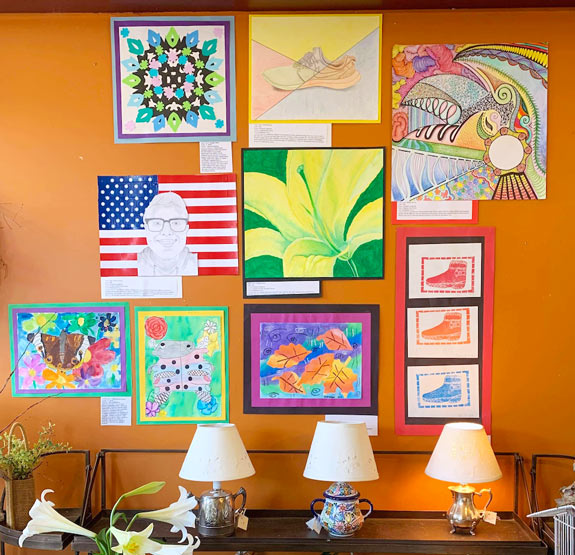
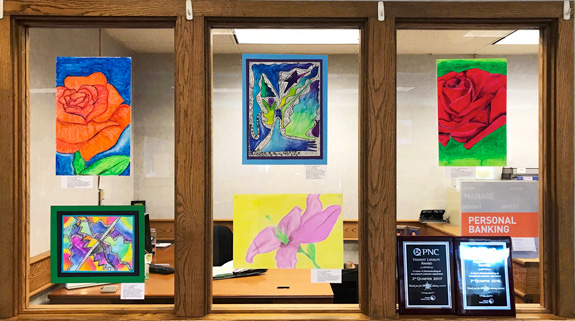
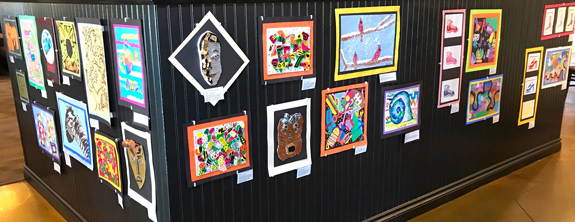
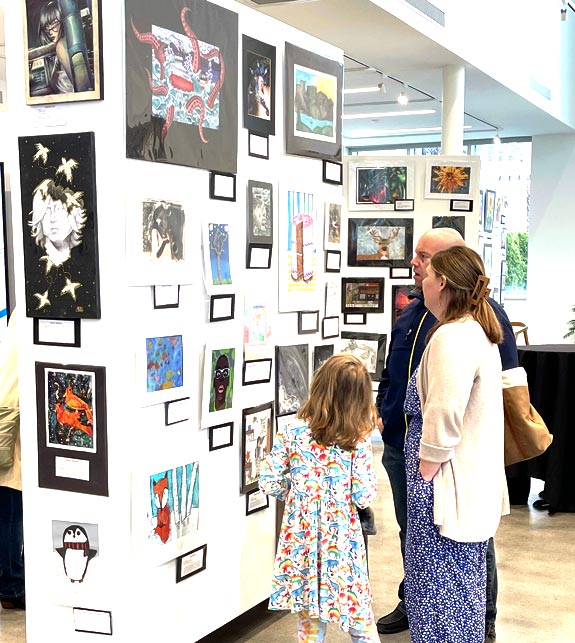
Promoting music programs, sports teams, and academic achievement is commonplace in education. I often say, “Art is quiet, music is loud, sports are thunderous.” In art education, we don’t have parades or halftime shows, but we do have local businesses willing and excited to display student artwork. Displaying student art has become an annual tradition in our town through the ArtWalk, which features thirty to thirty-five pieces of student art (Y5–12) from each school.
Student pieces featured inside a local flower shop.Student artwork on display at the local bank.Student work exhibited inside a popular local restaurant.Visitors admire student artwork on view.
In our small district, with a limited number of art educators who serve multiple buildings, the ArtWalk has become an essential advocacy tool. The exhibit is truly loved by our community. What I value most about the ArtWalk is its impact on the middle grades, where it boosts student involvement in art electives, art clubs, and even a Junior Art Honor Society chapter.
Building an Annual Community Art Event
Our ArtWalk began in 2003 as a one-weekend show highlighting student art in the newly opened high school. We intentionally scheduled it alongside the spring band concert to take advantage of a built-in audience. We set up after school on Friday, hosted an evening reception, and took turns supervising the show. While the event was successful, the effort required for a single weekend was exhausting. We continued this format for several years until we found a better opportunity: the middle-school Drama Club’s spring play.
The art show was open before and after the play for three weekends. While the built-in audience of drama families was beneficial, daily access for the broader community was limited.
In 2014, we reimagined the event and officially named it the ArtWalk. We expanded the exhibit into local businesses for three weeks, hanging student artwork inside restaurants, banks, hair salons, a hardware store, the district library, and a bakery. The response was overwhelmingly positive, and we’ve continued this model ever since. New businesses reach out each year asking to participate, making this small-town event a lasting success.
Businesses benefit from the increased sales, especially at locations like our local ice cream shop and bakery.
Advocacy Tips
Advocacy efforts like this require organization, planning, and time, but the results—especially at the middle-school level—are worth it. Students in grades 6–8 are often self-conscious about their work. A strong showing of middle-level art boosts confidence and strengthens the overall exhibition.
For districts interested in starting a similar event, particularly in the middle grades, consider the following tips:
Begin saving artwork early in the school year.
Decide how many pieces each teacher will submit.
Standardize labeling (student first name and last initial, grade level, medium, brief description, and teacher name).
Determine matting expectations and plans for 3D work; consider teaching students how to properly mat and present artwork.
Confirm participating businesses by dividing contacts among staff.
Choose show dates early; we set up on Thursday or Friday, open Saturday, and close after three weeks on the Monday following Mother’s Day.
Create posters advertising the show; our high-school graphics department prints posters for storefront windows.
Design a certificate of participation.
Avoid placing artwork directly in storefront windows due to sun exposure.
Other Ways to Promote Advocacy
Additional advocacy ideas include creating a weekly art newsletter showcasing student work. I developed one using Canva; once the template is created, weekly updates are easy. Creating a QR code linked to your newsletter allows administrators and teachers easy access. Middle-school students can also help design a schoolwide art newsletter, supporting inclusion while teaching graphic design skills.
Reaching out to local newspapers is another effective strategy. Small-town papers are often willing to feature student art, particularly in online editions that are easy to share on social media.
If your school has TV monitors, consider displaying student artwork. Organizing this display is an excellent opportunity for a Junior Art Honor Society or middle-school art club.
Inviting school board members and administrators to visit during hands-on lessons such as clay, printmaking, or painting also builds advocacy. Students can even stand in as art teachers by demonstrating materials and techniques to visitors.
Conclusion
Advocacy isn’t difficult, but it does require planning. Annual art shows are powerful tools for promoting programs and encouraging students to continue pursuing art through middle school, high school, and beyond. Advocacy begins in the earliest grades but must be sustained through the middle grades to lead to a strong high-school program. Art is essential for all students and worthy of every spotlight. The more opportunities we create to showcase young artists, the stronger our programs become.
Dr. Jane B. Montero teaches art education at Eastern Michigan University. She is a frequent contributor to SchoolArts and co-edited the Jan/Feb 2024 and Jan/Feb 2026 issues. DrJaneMontero@Gmail.com
National Standard
Connecting: Relate artistic ideas and works with societal, cultural, and historical context to deepen understanding.
Art teachers advocate for their programs, their students, and themselves. Young students foster positivity and intergenerational connection through mandala displays, elementary students collaborate with a local artist to problem-solve and construct papier-mâché houses, middle-school students create illustrated dictionary pages to share with the community, high-school photography club students use their voices to advocate for a full class, and more.