World Maritime Day: art by Simon de Vlieger (1600/1601-1653 Netherlands)
Starting in the late Renaissance, the Dutch republic prospered greatly off of their international maritime trade. The International Maritime Organization emphasizes World Maritime Day every year on the last Thursday of September. World Maritime Day focuses on shipping safety, maritime security, and the marine environment.
September 24 is World Maritime Day: art by Simon de Vlieger (1600/1601-1653 Netherlands)
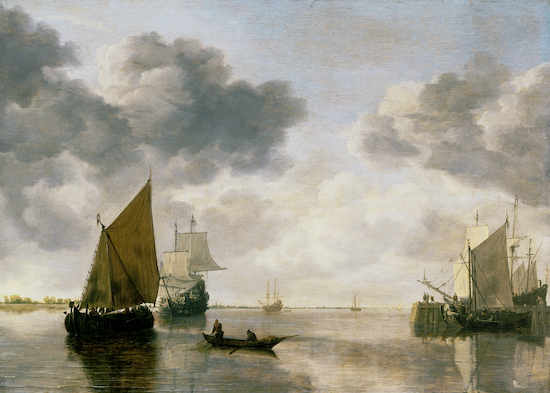
| Simon de Vlieger, Marine, 1652-1653, oil on wood, 60 x 83 cm © 2026 Philadelphia Museum of Art (PMA-2640)
|
De Vlieger’s influence on Dutch marine painting was decisive. He established a format of seascape that influenced other Dutch painters and artists from subsequent generations -- a low horizon with a sky filled with expansive clouds. His early tendency to portray dramatic rocky coasts gave way to peaceful marine vistas of great depth such as Marine. His well-structured compositions and calm seas influenced the work of Jan van de Cappelle (1624-1679). Colors in his late seascapes like this one became brighter with warmer tonalities, possibly in response to Van de Cappelle's work.
Even de Vlieger's few history paintings have marine settings. His rare landscapes anticipate works by Jacob van Ruisdael (1628-1682) and Meyndert Hobbema (1638-1709), his most successful student. De Vliegher also influenced later generations of painters outside of Netherlands particularly on the Hudson River School in the US and the Barbizon School in France. He also impacted English Romantic landscapists such as Thomas Gainsborough (1727-1788) and John Constable (1776-1837).
Background
Baroque is a term used to define art of the period (ca. 1600-1750) in western Europe that followed the Renaissance (ca. 1400-1600). No one style or set of stylistic principles define this period. The word comes from barocco, a Portuguese word for an irregular pearl. Art critics in the 1800s coined the term to disparage some of the unstructured, over-ornamented, theatrical and grotesque art of the post-Renaissance period.
During the Baroque period, a variety of stylistic trends co-existed, and often intermingled. The major trends were naturalism, classicism and drama. After domination by the Spanish since 1516, the Dutch provinces declared independence from Spain in 1581 and thus established the Dutch Republic. While the southern Lowlands remained dominated by Roman Church, the provinces of the Netherlands were Protestant.
Dutch art of the Baroque period maintained the same ideals of naturalism and detail as Renaissance painting in the North. However, in contrast to Catholic countries, Dutch artists developed their own hierarchy of subjects and styles, reflecting their reformed religion and the absence of a dominating church. While some religious subjects persisted, portraiture, genre scenes, landscape and still life became the predominant arena of Dutch painting. Calvinistic Protestantism swept away any classical, historical or religious subjects, emphasizing the predominant middle-class culture.
One of the subjects which Dutch Baroque painters raised to a high level of refinement and aesthetic appreciation was the seascape. Born in Rotterdam and working there and at Amsterdam, Simon de Vlieger, in the 1630s and 1640s, was one of the best-known, most important and influential of the emerging genre of Dutch maritime painting.
De Vlieger was the link between the turbulent tonal paintings of his teacher, the marine painter Jan Porcellis (1583-1632) and the sun-filled calm images of his student Willem van de Velde the Younger (1633-1707). De Vlieger moved in 1634 to Delft, where he joined the Guild of Saint Luke, and then to Amsterdam in 1638, though he maintained a house in Rotterdam until 1650 when he moved to Weesp on the outskirts of Amsterdam.
While he understood well the ships sailed by the Dutch, it was de Vliegher’s acuity with depicting light and atmospheric effects on water and sky that distinguishes him from most seascape painters. His paintings are symptomatic of the Dutch Baroque artists’ pride in reflecting on the life of his fellow Dutch people, and the qualities of their life that made them a world shipping power.
He eschewed the reserved palette of some painters such as Jan van Goyen (1596-1656) and was equally adept at painting calm seas in a harbor as he was at depicting storms at sea. He also painted figural representations for churches, genre scenes and landscapes, and was also an etcher. De Vliegher also designed tapestries, stained glass windows, and organ screens.

Comments