National Native American Heritage Month: art by Felipe Ortega (1952-2015, Jicarilla Apache, New Mexico)
Basketry was the more common utilitarian object made among the nomadic Apache band. However, both basketry and ceramics of the Apache were traditionally the province of women artists, just as it was among the Pueblo native bands. In contemporary First Nations cultures, there are an equal number of men to women ceramic artists. Felipe Ortega, called by Craftsmanship Magazine “The Clay Conjurer”, was also a linguist and healer, whose mentor in ceramics was a 90-year-old craftswoman.
November is National Native American Heritage Month: art by Felipe Ortega (1952-2015, Jicarilla Apache, New Mexico)
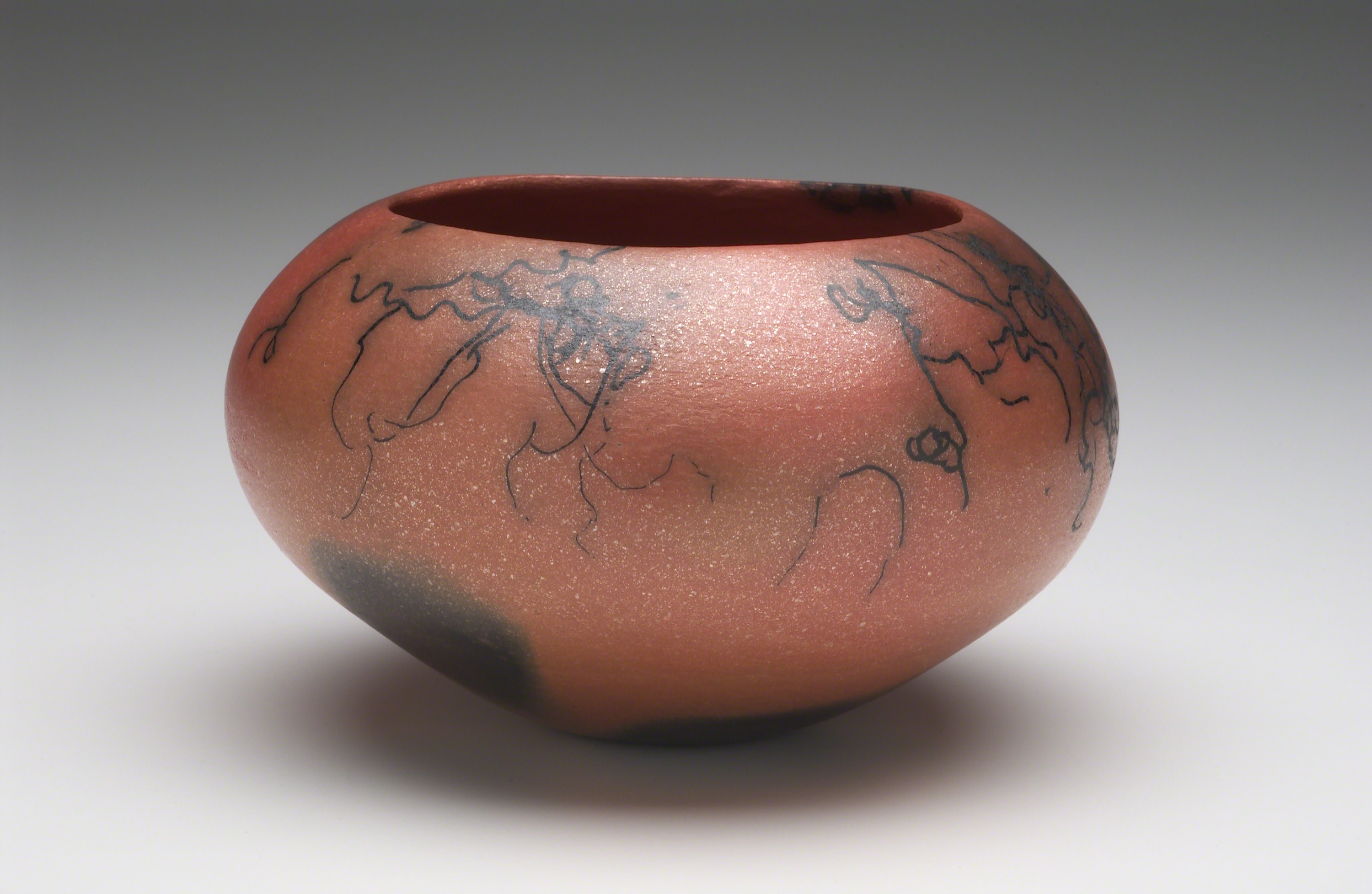 |
| Felipe Ortega, Pot, 1995, micaceous clay, 19.1 x 10.8 x 19.1 cm Mint Museum, Charlotte, NC, © 2026 Artist or Estate of Artist (MIN-246) |
Visible in this bowl are the little shiny flecks of mica in the clay. The clay is considered particularly good for the cooking of beans, a staple in the diet of many Southwest indigenous peoples. It is a plant that does not need alot of water to grow in the arid environment, and it delivers lots of protein and nutrients. Ortega considered micaceous clay pots to be a symbol of not only a traditional aspect of Jicarilla Apache culture, but an object for cooking that helped his ancestors survive.
Background
The ancestors of the Apache are thought to have migrated from somewhere far to the north, perhaps western Canada as a subgroup of the Athabascan linguistic family groups who all migrated from there (save the Navajo). Before the Spanish invasion, they were in Arizona, Colorado, New Mexico, Texas and Mexico by 1100 CE. There were also some Apache in Kansas as late as 1700. Culturally, they are divided into the Eastern and Western branches, the Jicarilla belonging to the Eastern.
After they got the horse from the Spanish, the Apache changed from subsistence farming life to a more mobile culture. They initially attempted to accommodate the Spanish and Americans. The Jicarilla's farming practices expanded greatly in the southwest, the culture becoming more firmly settled. They continued to suffer from the Comanche, who had originally chased them out of the upper Midwest and West. Although the Jicarilla did engage in some hostilities in the 1850s, they were subdued by the US army in 1880. In 1887 they occupied a reservation in north central New Mexico.
Felipe Ortega is a Jicarilla Apache medicine man and ceramic artist. Although originally prepared to enter the Catholic priesthood, he instead turned to ceramics in order to prove his mother wrong that a cooking pot made of micaceous clay (clay with aluminum silicate minerals in high quantity, developed from eroding bedrock) could make him like eating pinto beans.
While searching for that pot near his home, he happened upon a blind, 90 year old potter who taught him how to make vessels in this unique clay that exists near the Jicarilla reservation. Ortega gradually claimed that he was the "fastest coiler in the West," referring to the traditional First Nations technique of building pots with coils of clay.

Comments