Artist Birthday: Bruce Conner (1933-2008 US)
Of the many art movements that contested the supremacy of Abstract Expressionism in the middle of the 1900s, Neo-Dada was one of the most compelling, featuring Happenings, deconstruction, audience participation and more. Bruce Connor was a key player in the Neo-Dada of the mid-1900s.
Artist Birthday for 18 November: Bruce Conner (1933-2008 US)
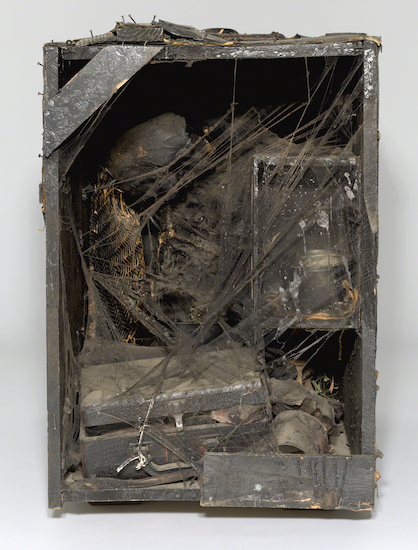 |
Bruce Conner, The Box, 1960, wax figure, suitcase, tin cans,
shredded nylon stockings, and other materials in wooden box,
891.7 x 51.7 x 89.3 cm The Museum of Modern Art, New York,
© Estate of Bruce Conner / Artists Rights Society (ARS), New York (MOMA-P5027)
Most of the sculptures Conner produced between 1958 and 1963 repeat a similar motif, evoking spiritual issues surrounding death and more concrete concerns of that period which included the Cold War, the possibility of nuclear war, capital punishment, and involvement in foreign wars. These works have been dubbed Conner’s Black Wax Sculptures series. He drew much influence from the box assemblages of Surrealist Joseph Cornell (1903-1972)
The Box is made of a bizarre collection of what one art historian termed as “meaningless junk” that incorporates a human tragedy – the constraints of social norms and hypocritical morals on individuals. The individual portrayed in The Box – made of such things as a figure composed of wax, cloth, and metal lashed together with nylon stockings – symbolizes a child cramped in a box trying to grow but bumping its limbs on the sides of the box, a symbol of US society’s moral and political inequities.
Background
During the 1950s, American artists increasingly felt no need to compete with European art. The “triumph” of Abstract Expressionism theoretically proved the “superiority” of American modern art. Some artist worried that American art had become complicit with mainstream ideals of conformity and consumerism. These artists critiqued the dominance of Abstract Expressionism and mainstream American culture in new stylistic trends from Pop Art to Neo-Dada.
The roots of Neo-Dada were found in the original Dada movement that originated during World War I (1914-1918), with artists who questioned what the very nature of art was in light of the lack of “logic” that led to that disastrous war. Blending dance, poetry, painting, photography and music rejected a central focus by artists seeking more alternative and expansive forms of expression. The motivation was to make art “come to life” and reach as many people as possible. Neo-Dada artists reinvigorated the potential and possibilities of American modernism.
Bruce Conner was born and raised in Kansas, a state he described as a place where anybody who deviated from “the norm” was ostracized. This perception laid the groundwork for a career as an artist who rejected traditional art education. As a child he like drawing, but was rejected from classes for going “against the rules”. By age 8 his parents got him private drawing lessons. He found his high school art classes “boring”, and was a rebellious college art major, although he received a BFA from the University of Nebraska in 1956.
Conner’s most profound experience which began his lifelong search for alternate states of consciousness came after he laid down and watched the sun. He studied and flunked our of several other college programs, founding the Experimental Cinema Group. After being rejected from 20 galleries in New York, his film shorts and collages were accepted at Charles Alan Gallery. In 1957, he moved to San Francisco where the non-conformist ethos of the city naturally drew him. He became part of the Neo-Dada art scene, and a group of artists called the “Beats” (after the term beatnik).
Beat artists rejected materialism, consumer culture, and standard narrative in favor of spirituality through a range of Western and Eastern religions. Conner’s widely varied body of work stemmed from his avoidance of being pinned to a single style. Around 1963 he turned from collage and assemblage to drawing and painting into the 1970s. He documented West Coast punk subculture in photography during the 1980s 1990, also once again producing collages. In the 2000s he produced prints and tapestries using digital technology.

Comments