
US Navy Birthday: art by Thomas Birch (1779-1851 US, born Britain)
Navy Secretary Admiral Zumwalt declared October 13 the US Navy’s birthday in 1972. The Continental Congress established the US Navy in 1775. At the time, the colonies only had two ships with a total of 75 service personnel! Interestingly, the USS Constitution is still considered to be in service. The official US Navy formation occurred in 1794.
October 13 is the US Navy Birthday: art by Thomas Birch (1779-1851 US, born Britain)
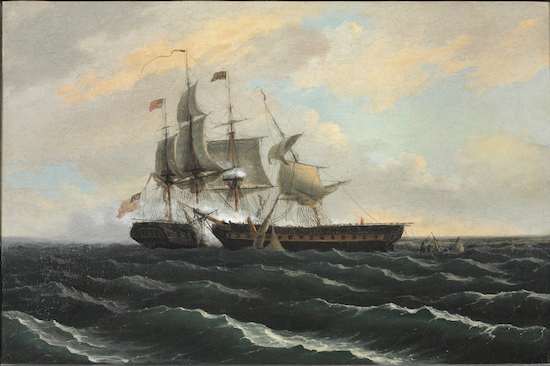 |
| Thomas Birch, The Constitution and the Guerriere, 1831, oil on canvas, 71.1 x 91.4 cm © 2026 Philadelphia Museum of Art (PMA-7690)
|
Thomas Birch was one of the earliest American artists to embrace landscape in his body of work. In addition to views of Philadelphia, Birch produced views along the Fairmount and Jersey shores, and harbor scenes of Philadelphia and New York. The naval battle between the American ship Constitution and British frigate Guerriere took place in 1812 400 miles southeast of Halifax, Nova Scotia. Dramatically depicting a key battle during the War of 1812, Birch painted the British and American battles based on engravings he and his father had produced during the war. Birch emphasizes the drama of the battle between Britain, his native home, and his adopted country, the United States
Background
There was virtually no tradition of landscape painting during the 1700s in the US, save for overmantle decoration (a painted woodland scene above a fireplace, usually part of the wall), and as backgrounds in portraits. In the 1800s, after the Revolution, Americans, and Europeans alike came to appreciate the unique and spectacular nature of the American wilderness. After 1825 saw the flowering of the landscape as subject matter in American painting.
As Americans cleared the wilderness and tilled it for farms, constructed canals to increase commerce, and exploited the land for growing industrialization, Americans became nostalgic for what they knew they were slowly losing -- their unique wilderness. Authors and artists began to create romantic reminiscences of the American landscape before the Industrial Revolution. The movement now called the Hudson River School came to embody the ideals sought by Americans in views of their country. It is so named because many of the artists did landscapes up and down the length of the Hudson River in New York.
The American school of landscape painting grew rapidly between the 1820s and 1850. Each artist brought a different emphasis to the genre. These artists variously specialized in farms, harbors and coves. While few of these landscape artists painted cityscapes, farm scenes and harbor scenes were quite popular, patriotic odes to the new republic.
Thomas Birch was born in London, son of artist (engraver) William Birch (1755-1834). Birch and his father emigrated to Philadelphia when Thomas was 15. In Philadelphia he worked with his father as William Birch and Son, creating engraved views of Philadelphia.
It was during the War of 1812 (1812-1815) that Birch developed an interest in landscape paintings, in a period that saw him producing paintings of heroic American naval battles. He became renowned for his landscape-style depictions of harbors. These views were slightly romanticized, but were accurate portrayals. While developing as a landscape painter, he is said to have walked the banks of the Schuylkill River with fellow painter, portraitist Thomas Sully (1783-1872) searching for picturesque views to paint. His romantic-realist style had a great impact on the later Hudson River School artists.

Comments