
This Day in History: Passing of Pietro Longhi (1702-1785 Republic of Venice)
The Republic of Venice was established as a Duchy of the Byzantine Empire in 697, and was nominally its own country until Napoleon conquered Italy in 1797, not long after Pietro Longhi’s passing. Longhi’s art reflects the wealth, sophistication, and up-to-date artistic aesthetics that Venice was home to for centuries.
This Day in History 8 May, 1785: Passing of painter Pietro Longhi (born 1702 Venice)
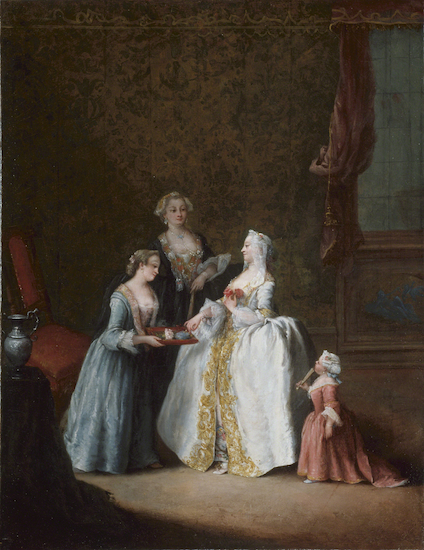 |
| Pietro Longhi, Woman at Her Toilette, ca. 1740, oil on canvas, 56.9 x 43.9 cm © 2026 Art Institute of Chicago (A6448)
|
Longhi's depiction of elegantly dressed wealthy people is worthy of French Rococo painting. The glittering elite are contrasted against a neutral background. Focusing on rich people fussing about their morning dress routine is an ironic artistic statement. It reflects the common dissatisfaction with the upper classes, a sentiment that, in some countries, built towards the democratic revolutions in the late 1700s.
Longhi's genre scenes typically feature elegantly dressed women as the central focus. In this toilette scene, they are dressed in the height of Rococo French fashion, with even the female toddler sporting the side hoops (paniers) in her skirt, with the waist-slimming stomacher in her bodice, while holding a fan. The woman completes her toilette by deciding which flowers to adorn her bosom with. The characters are inevitably generalized idealizations of fashionable young people with more emphasis on the elegance of the idle rich rather than specific individuals. Longhi's interiors also express the conceits of the wealthy in their fashionably appointed apartments. In this painting, he details the fad for anything Chinese or Japanese for the wealthy during the Rococo period in the Chinoiserie pattern of the wallpaper.
Background
While the paintings of the French Rococo celebrate the mindless frivolity of the ruling class, many artists of the 1700s, particularly in Britain and Italy, enjoyed using the visual language of the Rococo in subjects that focused on everyday life. This was particularly effective in works that pointed out the artificiality of social conventions among the wealthy, a reflection of Enlightenment ideals.
Italy had no central court that guided the development of a distinctive Italian school of painting from Renaissance times on. Painting styles still varied from region to region oriented around major cities -- Florence, Rome, and Venice.
Pietro Longhi, born and based in Venice, originally trained as a history painter, but later studied under the genre painter Giovanni Maria Crespi (1665-1747). His genre subjects bear the influence of the French Rococo artist Nicolas Lancret (1690-1743), but, they also include elements of Dutch Baroque genre painting, a large collection of which existed in Venice at the time. He devoted himself to scenes of everyday life, and produced some portraits and landscapes.

Comments