
September Contemplated with Claude Monet (1840-1926 France)
You might know I would use any excuse to show a Monet. This may be one Monet with which you are not familiar, but it is a wonderful prefiguration of his rapidly developing Impressionist style and palette. What better way to mark the beginning of September?
September Contemplated with Claude Monet (1840-1926 France)
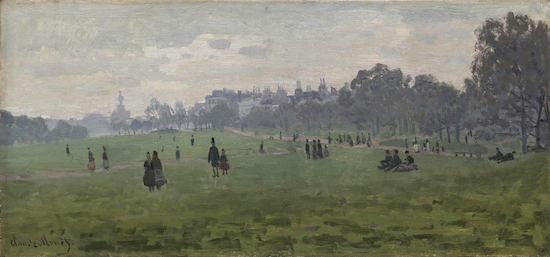 |
| Claude Monet, Green Park, London, 1870/1871, oil on canvas, 34.3 x 72.5 cm Image © 2026 Philadelphia Museum of Art (PMA-8134)
|
In September of 1870, at the outbreak of the Franco-Prussian War (a war between France and Germany), Monet and wife fled France and took refuge in London until 1871. This panorama of Green Park prefigures his full-blown Impressionist palette, but there are scrumptious passages of cobalt violet defining the bordering forms of the park. Monet had studied the works of Romantic landscape painters Turner and Constable, and this painting is a turning point towards a brighter, purer color palette that eventually triumphed in his An Impression Sunrise.
Although Monet used black and gray to describe the figures in the park, visible in this work is the defining of the ground with no under painting, just pure vibrant green, and the use of violets to define the overcast skies and misty forms of city buildings, a definite influence of the atmospheric works of Turner, and a digression from academic tradition.
Background
Claude Monet studied at the conservative Academy Gleyre in Paris during the mid-1860. It was the Barbizon painters, however, who had a lasting influence on his work. The Barbizon School artists, painting in the Realism style, were the first artists to emphasize painting landscapes outdoors, a previously almost unheard of practice among landscape painters. Barbizon Realist Eugène Boudin (1824-1898) and fellow outdoor landscape painter Charles Daubigny (1819-1878) had the greatest impact on Monet’s work.
At the same time that Monet came under the influence of the Barbizon painters, he also met a group of aspiring painters at the Academy Gleyre who were working towards the same goal -- a fresh, spontaneous way of looking at the world around them. These artists were Auguste Renoir (1841-1919), Frédéric Bazille (1841-1871) and Alfred Sisley (1839-1899).
Dissatisfied with the conservative academic curriculum, these artists left to paint on their own. Painting together at Le Grenouillère outside of Paris, the first pure Impressionist paintings took form. They were a departure from academic standards, being sketchy, in pure colors applied directly to the primed canvas, rather than being mixed on the palette.
After seeing the work in London of Joseph M.W. Turner (1775-1851) and John Constable , two English romantic painters who emphasized atmosphere and light, Monet’s mature style crystallized. Monet returned to Le Havre, where he painted An Impression, Sunrise. This painting gave the movement its name. It was displayed in the First Impressionist Exhibition in 1874 in Paris.
Monet and family lived in near-poverty during the 1870s. By the late 1880s his perseverance with the Impressionist style paid off. His first big success was at an exhibition in 1889 where he showed his paintings alongside a showing of Rodin’s sculpture. He was well on his way to becoming an established artist.
Monet carried the dissolution of form farther than any of the other Impressionists. His last paintings were enormous in scale, due partly to Monet’s poor eyesight, but maintained the bright, pure color palette he had started using in the early 1870s. The great Post-Impressionist painter Paul Cézanne (1839-1906) once said that Monet was no more than extraordinary "eye".

Comments