National Packaging Design Day: Art by Ruben Rausing
National Packaging Design Day was first observed in 2015. Design Packaging, a company known for crafting creative and functional packaging, established this day to honor the designers who bring products to life through aesthetic visual and structural design.
7 May is National Packaging Design Day: Art by Ruben Rausing (1895-1983 Sweden)
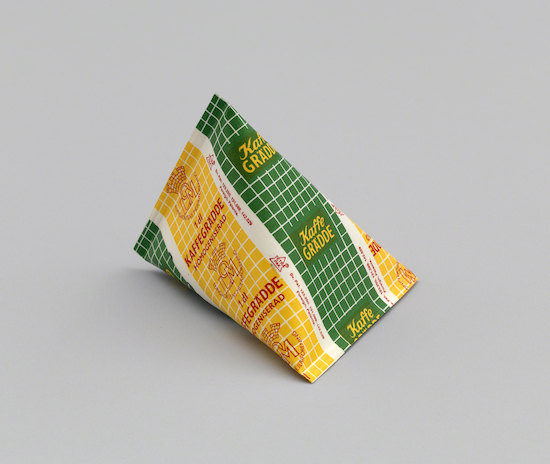 |
| Ruben Rausing (designer), for Tetra Pak (manufacturer, founded 1951, Lund) Tetra Classic, carton with plastic coating, 8.9 x 8.3 x 8.3 cm The Museum of Modern Art, New York, © 2026 Artist or Estate of Artist (MOMA-D1244)
|
With no prior experience to build upon, Rausing's company investigated which basic geometric shape best-suited the containment and fluid-tight packaging for milk. The solution was a cylinder sealed vertically on one end and horizontally on the other forming a tetrahedron. In order to provide sanitary, air-tight seals, the milk filled long cylinders and heat clamps would then separate the cylinder into a number of tetrahedrons.
The machine for filling and sealing the milk was developed by Harry Jarund and Nils Andersson starting in 1945. A large-scale model was not available until 1952. The machine was called the Tetra Pak. Its development included the design of a rigid-enough paper with a plastic coating that resisted heat, light and moisture. In the same year that the Tetra Pak debuted, there began the production of coffee cream in 1/10 of a litre tetrahedrons.
Background
Since the writings of the ancient Greek philosopher Plato (427-347 BCE), Western aesthetics have been dominated by the ideas of the superior beauty of basic geometric shapes. These ideas were set forth in Plato's writings Phillebus, in which he declared that basic geometric shapes were "eternally and absolutely" beautiful.
In the 1900s, this aesthetic transferred to industrial design. This aesthetic was pushed by such schools as the Bauhaus in Germany (1919-1933), which emphasized the merging of industrial design with fine art. After the 1920s, it became a matter of conscious aesthetic preference among corporate designers.
Ruben Rausing was born near Helsingborg, Sweden. He studied at the Stockholm School of Economics and received a MS in finance in 1920 at Columbian University in New York. He remained in America until 1929 and studied large-scale American industry.
Rausing was particularly intrigued with the advances American companies had made in pre-packaging for food and convenience stores that afforded self-service capabilities in the rapid urbanization of America. Realizing that this trend would soon flow to Europe, he returned to Sweden and invested in a packaging company, Akerlund and Rausing.
By the 1930s, Rausing had fashioned Akerlund and Rausing into the forefront of modernization of packaging for Swedish retail stores and supermarkets. His primary objective initially was to replace bulk (open) selling of such commodities as flour, sugar and salt with modern packaging. The solution of the packaging of perishables such as milk was engaged between the mid-1930s and the mid-1940s.
Correlations to Davis programs: Explorations in Art 2E, Grade 6, lesson 5.6; A Personal Journey 2E, lesson 3.6; Experience Art, lesson 8.3; Communicating Through Graphic Design 2E, Chapter 5; Davis Collections -- Graphic Design

Comments