National Italian-American Month: art by Joseph Stella (1877-1946 US, born Italy)
Many Italian American artists at the turn of the 1900s were influenced by modernist art movements in Europe and inflected nascent American modernism with them. Joseph Stella worked in Futurism, Cubism, and realism in his painting career. National Italian American Month was proclaimed in October 1989 by President Bush to honor the many Italian American contributions to American culture.
October 30 is National Italian-American Month: art by Joseph Stella (1877-1946 US, born Italy)
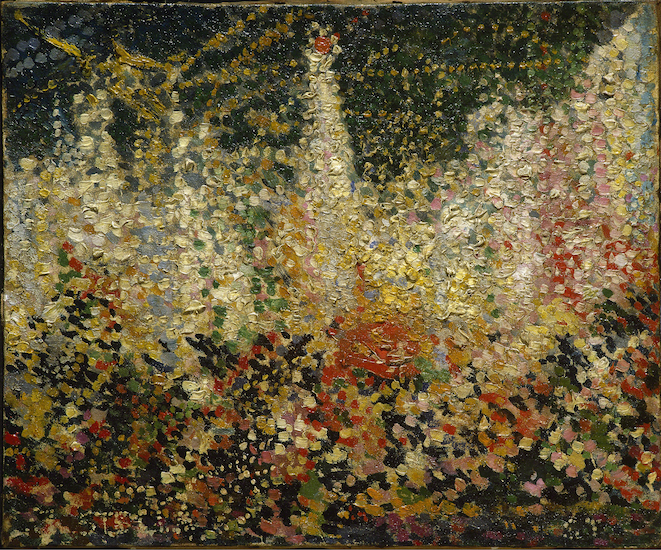 |
| Joseph Stella, Study for Battle of Lights, Coney Island, Mardi Gras, 1913, oil on canvas, 25.3 x 30.5 cm Hirshhorn Museum and Sculpture Garden, Smithsonian Institution, Washington, DC, © 2026 Artist or Estate of Artist (SI-305) |
A trip to Italy and Paris 1909 to 1912 exposed Stella to Futurism and Cubism, and he subsequently abandoned his academic realism, incorporating Futurist principles into his art. He followed the group's advice not to look to the past for material but to embrace the present, dynamic culture. In 1913 he submitted two works to the Armory Show.
Shortly after that he painted several works entitled Battle of Lights, revolving around the shiny, modern electrified atmosphere of Coney Island, a summation of urban modernism. The Battle of Lights paintings are considered the first examples of American Futurism.
Futurism appealed to Stella because it encompassed all things modern -- technology, machines and urban life, all of which he could visualize from his residence in New York. Stella's brand of Futurism stemmed from the goal to illustrate multiple impressions and senses in a single painting. While this adhered to the Futurist idea of documenting a series of moments, Stella's composition were more structurally solid than many of the Futurists, and he never explored total abstraction. His painting shows a competent adaptation of the Pointillist technique that only characterized his style for about five years.
Background
The penchant for no-nonsense realism pervaded American art through the early period of the 1900s. The seeds of modernism had been sewn by American painters in the 1880s who had pursued artistic training in Paris rather than the traditional England or Germany, exposing them to the revolutionary Impressionist movement. Impressionism was not well-received in the US, nor were other movements, such as the Ash Can School, that bucked against Academic strictures on subject matter and style.
This attitude would change markedly after the Armory Show of 1913 which exposed American artists, and the public to radical modernism from Europe such as Post-Impressionism, Cubism, Futurism and forms of geometric abstraction. However, many American artists were already aware of modernist experiment, living and working in Paris, before the Armory Show. When returning to New York, they too helped disseminate these ideas, many of which took on decidedly American interpretations.
Stella was born in Italy, emigrating to the US 1896, ostensibly to study medicine and join is brother Anthony who was already an established doctor in New York. While enrolled in medical school, he attended an antique class at the Art Students League in New York. He soon discovered his true passion was to be an artist and he abandoned medical school. He studied at the New York School of Art under American Impressionist William Merritt Chase (1849-1916), developing a liking for Dutch, Italian and Flemish Renaissance and Baroque masters.
When Robert Henri (1865-1929), leader of the Ash Can School artists, began teaching at the New York School of Art in 1903, Stella was excited by his ideas that no subject was too mundane for an artist. Between 1905 and 1909 he worked as an illustrator, often providing depictions of immigrants in New York for social activist publications.
Correlation to Davis Program: Davis Collections -- Western Art Style: Pointillism

Comments