National Hermit Day: art by Pu Ru (1896-1963 China)
Chinese painter Pu Ru truly embodied the spirit of the tradition of the Chinese individualist, scholar/amateur painter (the so-called literati). According to National Day Calendar: October 29th is believed to honor Saint Colman of Kilmacduagh who died in 632 CE. This Irish Saint spent a seven-year hermitage in the Burren Forest in a cave in County Clare, Ireland. Saint Colman chose to live in isolation and viewed to have possessed profound spiritual discipline. This date and National Day are linked to Saint Colman's memory and the legacy he left.
October 29 is National Hermit Day: art by Pu Ru (1896-1963 China)
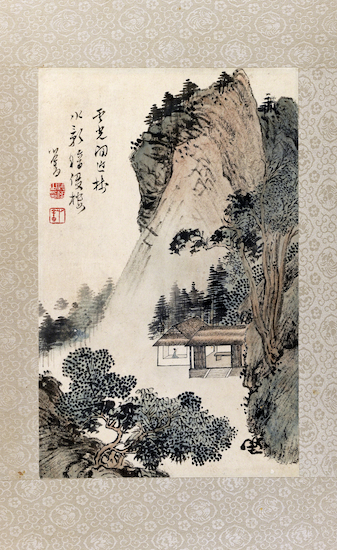 |
| Pu Ru, Mountain Landscape, ca. 1950, ink and colors on paper, 26 x 16.5 cm Brooklyn Museum of Art © 2026 Art or Estate of Artist (BMA-2469A)
|
By the 1930s and 1940s, Pu was an accomplished traditionalist painter who was highly regarded for both his painting and his calligraphy. After the Communist takeover, Pu moved to Taiwan where he taught at National Taiwan Normal (Teaching) University. He came to exercise a strong influence over the painters in Taiwan. This landscape shows very little digression from traditional formats. The image of a hermit-scholar in a mountain pavilion is a time-honored Chinese painting subject, but may also refer to Pu's years in the monastery.
Background
During the Qing Dynasty (1644-1912), Chinese painting continued the traditional distinctions between the professional painters and the amateur/scholar painters (the literati). After the Open Door Policy was forced on China by Western powers after the Opium War (1839-1842), five Chinese ports were open to trade with the West. Chinese began to learn substantially more about Western art.
After the collapse of the Qing and establishment of the Chinese Republic in 1912, many young Chinese painters began to study Western art, first in Japan where schools were already established since the 1860s, and, after 1918, in Europe itself, mainly Paris. A few of the Chinese artists stayed in Europe.
Those who returned to China did not find an eager audience for their Westernized styles. Some resumed traditional Chinese modes of expression, while some mixed traditional with western. Westernized styles were most popular in the cities of Shanghai and Tianjin. There were, however, some die-hard traditionalists who persisted in the centuries-old styles and subject matter.
Under Communist rule after 1949, artists were forced by the government to exhibit in a Social Realist style as propaganda for the regime. Those artists who persisted in the traditional Chinese style adapted their style to the times by adding such small concessions as tractors or factories in landscape paintings. Western art was considered decadent.
Pu Ru, born Pu Hsin-Yu, was a member of the Qing dynasty's (1644-1912), ruling Manchu family, a cousin of the last Chinese emperor Py Yi (1906-1967). A talented child, he began studying calligraphy at the age of 4, however, he never received training in painting.
After studying in Beijing Pu went to Germany where he received degrees in 1922 in biology and astronomy. He never pursued those as a profession. On returning to China, then under Japanese control, he moved to Je Tai Monastery in Hsi-Shan to live in seclusion and study the historic arts of calligraphy, poetry, and painting in the centuries-old tradition of the scholar/amateur artists, who, in a sense, were hermits because of their vocation.
Correlations to Davis programs: Experience Painting, Chapter 1 Studio Experience; Davis Collection -- Chinese Art

Comments