National Fashion Day: Art by Fernand Siméon (1884-1928 France)
National Fashion Day evolved in 2016, the result of an internet movement of fashion designers, influencers, and independent brands to celebrate the unique creativity of everyday fashion as a foil to the dictates of the “fashion industry”. The history of fashion advertising has been a fascinating genre of art that had its beginnings in the 1700s.
9 July is National Fashion Day: Art by Fernand Siméon (1884-1928 France)
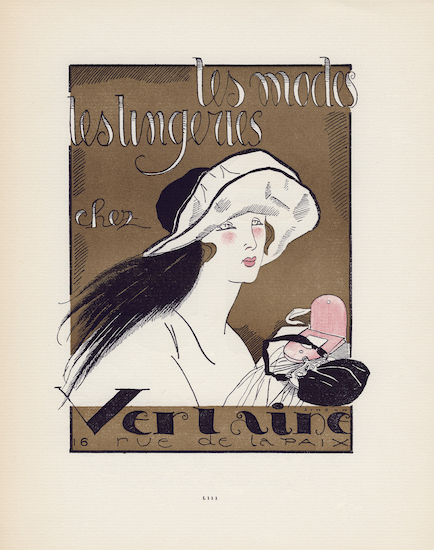 |
| Fernand Siméon, Advertisement from the Gazette du Bon Ton: The fashions, the lingerie, House of Verlaine, September 1920, color lithograph on paper, 25.43 x 19.1 cm Image © 2026 Museum of Fine Arts Boston (MFAB-595)
|
In order to sell fashion products, advertisers had to resort to objectifying their target (women) and presenting unrealistic, idealized and often very attenuated figures of women. The extremely long neck on this model is meant to contrast with the extravagant cloche-like hat, and bobbed hair peeking out from under it. Naturally this is not a look that could even be aspired to, but it became standard in the fashion industry. Impossible beauty standards endure to the present day, particularly in the form of vaunted super models of both genders.
Before the end of the 1910s, Western women generally did not cut their hair during their entire life. After World War I (1914-1918) with its substance privations and women in war jobs, the spirit of "the new woman" was born, liberated from the fashion restrictions of the past such as corsets (girdles) and elaborate up hairdos.
The Marcel Waive of the late 1910s, in which women first allowed their hair to be cut, paved the way for the boyish bob of the 1920s, in which women's hair came up to well above the shoulders. The shorter hair encouraged the cloche hat, a deep-crowned "turban" influenced by the "Arab" fashions of the popular Ballets Russes.
This is an early example of the cloche design, which often concealed the eyebrows. By the mid-1920s, the big feathers and large brims had disappeared. This was the beginning of the period of the flapper.
Background
Fashion plates -- illustrations for the marketing of upcoming fashion trends -- did not exist in magazine form until the last quarter of the 1700s. There were certainly indications of what fashionable people wore before that going back to the ancient world. These primarily took the form of painted or sculpted portraits or painted genre scenes as documentation of what stylish people were wearing at the time.
The illustration of contemporary fashions in printmaking medium existed as early as the 1500s, although they were not meant as advertising or encourage sales of a particular designer. Albrecht Dürer (1471-1528) produced studies of what fashionable Italian women were wearing on his trips to Italy. The Bohemian Baroque artist Wenzel Hollar (1607-1677) documented the fashionable dress (mostly women) of people from several countries in Europe. Jacques Callot (1592-1635), an artist primarily known for his print series The Miseries of War, issued a print series entitled The Nobility, which documented the fabulous dress of members of the French court.
Fashion plates, accompanied by indications of where materials and styles could be bought, were first introduced into a magazine called Le Mercure Galant in 1677, but the practice did not last as long as the magazine. Despite the seeming dominance of interest in Europe in what the French high livers were wearing, it was in Britain that the first systemic, widespread production of fashion prints, mostly for women, began.
The Lady's Magazine first appeared in 1770 in Britain. Rather than showing the coming extravagant styles for members of the nobility, this journal presented guidance for the ordinary woman of means. From that time on the idea caught on and the publications proliferated greatly. The Lady's Magazine was followed by La Cabinet de Modes (1780s) in France and Modealmanach (1780s) in Germany. The printing method was primarily engraving and etching, often with hand-coloring added.
The reign of Napoleon I (1804-1815) in France established Paris as the center of fashion design. With lithography replacing etched and engraved fashion plates, the number of journals dedicated to the latest fashions expanded greatly in France. French fashions and the style of fashion plates soon became the model on which many other publications throughout Europe and eventually in the US would be based.
The Gazette du Bon Ton (Journal of Good Taste) was a magazine of fashion trends, beauty and health tips from 1912 to 1925. Fernand Siméon was a book and magazine illustrator who also worked prolifically for fashion magazines. He is best known as an avid follower of the Art Deco style during the 1920s. Like all fashion plate artists, he illustrated costumes he saw either in the designer's workshop, or from the designer's own sketches for the clothes.

Comments