
July Interpreted by Larry Rivers (1923-2002 US)
Did you ever look at a work of art and something in the work evokes vivid feelings about an event in your own life, or just a general feeling you get when you visit a certain country or place? Well, maybe this Larry Rivers painting will reawaken memories of the 1950s or 1960s. Rivers’ name is often associated with Pop Art, but his early works cross the line into gestural brush work that remind us the 1950s were the period when Abstract Expressionism was dominating modernist art experiment in the US.
July Interpreted by Larry Rivers (1923-2002 US)
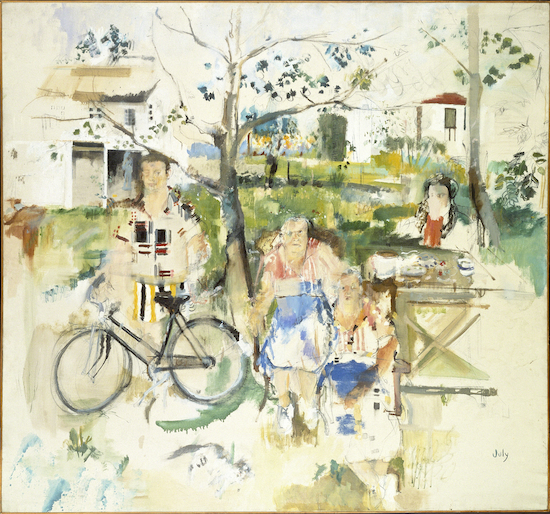 |
| Larry Rivers, July, 1956, oil on canvas, 213 x 230.8 cm Brooklyn Museum, © 2026 Estate of Larry Rivers / Licensed by VAGA at Artists Rights Society (ARS), New York (BMA-4952rivg)
|
In the mid- to late-1950s, Rivers very much wanted to associate his own painting with that of past periods in art history. He rebelled against the total abstraction of Abstract Expressionism, but his work incorporated the gestural brush work and brilliant color he had learned under Hans Hofmann (1880-1966) in the 1940s. July, painted in Southampton, Long Island, is a family portrait that features his mother-in-law Berdie twice (the mother-in-law of whom he painted a double nude portrait). The combination of a common family get-together with his action painting brushwork indicates that Rivers’ work is a bridge between Abstract Expressionism and Pop Art.
Background
From the late 1940s to the mid-1960s, Abstract Expressionism was the dominant modern American painting style. It was initially a rejection of the domination of the academic obsession with subject matter as the most important aspect of a work of art. Abstract Expressionists purposely ignored any literary, moral, social or narrative motives in their work. During the 1950s, movements evolved that reasserted figuration in painting.
Larry Rivers was born Yitzoch Loiza Grossberg in the Bronx, New York, changing his name to Larry Rivers in 1940. From 1940 to 1945 he worked as a jazz saxophonist in New York. In 1945 he turned his attention to painting at the school of famed German abstractionist Hans Hofmann (1880-1966) from 1947 to 1948. His earliest works were colorful variations on the styles of Neo-Impressionist Pierre Bonnard (1867-1947) and early Matisse (1869-1954). By the mid-1950s, he had developed a style that combined the painterly surfaces of the action painters of Abstract Expressionism with figuration, primarily in the form of portraits.
Rivers is often associated with Pop Art because he was the first artist to merge non-objective, non-narrative art with narrative and objective abstraction. Because his style changed many times throughout his career, strict identification with Pop Art is elusive. Only in the 1970s did he produce a body of work that was solidly Pop in spirit. He always remained committed to figuration in one for or another.
Correlations to Davis programs: Explorations in Art 2E grade 1, lessons 2.2, 5.4, 6.1; Explorations in Art 2E grade 2, lesson 5.1; Explorations in Art 2E grade 3, lessons 1.1, 1.4, 1.5, 4.3; Explorations in Art 2E grade 4, lessons 1.1, 4.4; Explorations in Art 2E grade 5, lesson 1.7, 1.8; Explorations in Art 2E grade 6, lessons 1.4, 1.5, 6.2; A Community Connection 2E lesson 2.2; A Global Pursuit 2E lesson 5.1; A Personal Journey 2E lesson 5.1; Experience Art lesson 2.1

Comments