International Workers' Day (May Day): Art by Diego Rivera (1886-1957 Mexico)
International Workers’ Day commemorates the 1886 Haymarket Riots in Chicago where workers were fired upon by police protesting for workers’ rights for an eight-hour work day after one protestor threw a bomb. The day was declared in 1889 at the Second International.
1 May (May Day) is International Workers’ Day: Art Diego Rivera (1886-1957 Mexico)
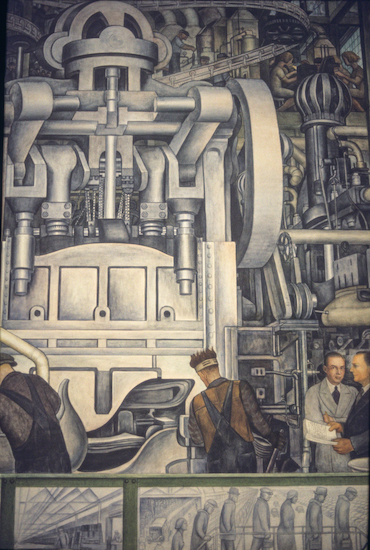 |
| Diego Rivera, Detroit Industry, south wall, Production of Automobile Exterior and Final Assembly, 1932-1933, fresco Detroit Institute of Arts, Image: John Rosenthal/Davis Art Images, © 2026 Banco di Mexico Diego Rivera Frida Kahlo Museum Trust / Artists Rights Society (ARS), New York (8s-19774riars)
|
Rivera traveled to the United States in 1930 when he was commissioned to paint murals in San Francisco. Most of these were influenced by American industrial society, and, different from his work in Mexico, he reined in his communist beliefs. In May of 1931, Rivera was commissioned to paint murals in the Garden Court (now Rivera Court) on the north and south walls of the Detroit Institute of Arts. The project was soon expanded to cover all four court walls. Between April and July of 1932, Rivera toured Ford’s River Rouge plant and other industrial sites, producing thousands of sketches for the Detroit murals.
The Detroit Industry murals consist of 27 panels spanning the four walls. Rather than portraying the Depression – a severe world economic downturn 1929-1940 – Rivera focused on the modern and high-tech auto and steel industries and its impact – both good and bad – on workers. The murals emphasize the relationship between man and machine, technology’s constructive and destructive uses, and the relationship between management and labor, all under the umbrella theme of the history of technology and mankind.
This close-up of the South Wall continues the saga of Production of Automobile Exterior and Final Assembly. This section contains the detailed machinery of a stamping press which makes fenders from large sheets of steel. In the foreground spot and seam welders do their work. To the right are Edsel Ford and William Valentiner.
Background
Diego Rivera began drawing at the early age of three. When he was ten his family moved to Mexico City where he enrolled in the San Carlos Academy of Fine Arts. There he came under the influence of social/political satiric artist José Guadalupe Posada (1815-1913). His first exhibition in 1907 was a great success and earned him a scholarship to study art in Spain.
Moving to Paris in 1911 Rivera was influenced by the Cubist works of Cézanne and Picasso, and by Surrealism. During his time in Europe, his painting style was one of a bright-palette Cubism. He also traveled to Italy where he was greatly impressed by the frescoes of Italian Renaissance artists such as Michelangelo (1475-1564).
When he returned to Mexico in 1921, the Mexican government commissioned him to paint a series of murals chronicling Mexican history and the Revolution (1910-1917). In an attempt to create a national Mexican style, Rivera rejected Europeans modernism and looked to the art of the ancient Mayans for inspiration. He had become fascinated with the Mexican Indian cultures on trips to the Yucatan in 1921 and 1922.
Rivera combined the large-limbed, rounded figurative forms of pre-Hispanic Mexican art with the classical fresco technique he learned in Europe, he developed his mature style for which he is best known today. It is characterized by solidly modeled forms, the influence of both Giotto and Mayan sculpture, the shallow frieze-like space seen in ancient Mexican manuscript painting, and decorative motifs seen in both relief carving and pottery decoration.

Comments