Hispanic American Heritage Month: Carlos Rodriguez (MARE 139, born 1965 US)
Hispanic American Heritage Month is 15 September to 15 October, 2026. I will say unequivocally, that there have been few if any periods in American art history that American people of Hispanic heritage have not participated in making art. And it is not simply because Mexico used to dominate a large swathe of the US way back when. American artists of Hispanic heritage, for example, were very instrumental in the birth of the American mural movement starting in the late 1960s into the 1970s, and reborn in the 1980s and 1990s with street art. Originating out of the “Brown Power” movement of the late 1960s, artists of Hispanic descent continue to play a major role in the vital Street Art movement of the 21st century!
Hispanic American Heritage Month is 15 September to 15 October: Carlos Rodriguez (MARE 139, born 1965 US)
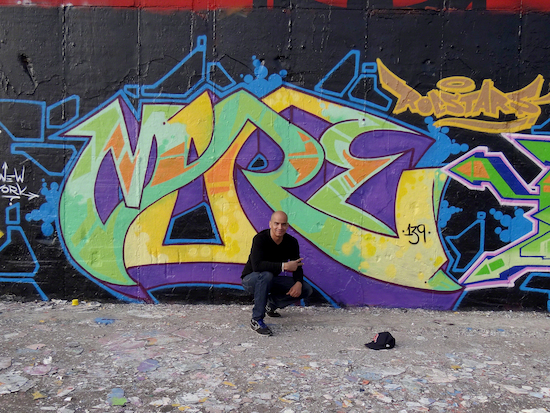 |
| Carlos Rodriguez (MARE139), MARE139 in front of his tag, 2012, Graffiti Wall of Fame, Berlin Image courtesy of the Artist, © 2026 Carlos Rodriguez (8s-30394) |
|
This MARE139 piece was painted in Berlin for Blankenburg graffiti hall of fame. Invited by local artists in 2012, Rodriguez rocked a flow style with connecting letter forms from one shape to the next. This piece has shapes and forms that create movement and balance. As a technique to create depth, Rodriguez uses complimentary colors for his volumetric 3D. The R in this piece has a stem to make it appear that it is kicking out. This gesture gives the feeling of movement to the work. Similar to his sculptural work, Rodriguez abstracts these letter forms with balance in space. Further exploring the connections between graffiti and global culture most of his work honors the written word and language. His home city, New York is represented on the wall as well as his crew ROCSTARS which is a noted crew of legendary graffiti writers. MARE139 is a noted pioneer of this culture and has innovated graffiti sculpture. Background The art form of graffiti has been around since the ancient world. It has been found in ancient Roman cities such as Pompeii, and has been discovered in ancient Mayan religious sites. In both cultures it was illegal to deface public buildings, but, the art form was also an important means of communication. Contemporary graffiti evolved in American urban areas starting in the 1960s. It spans all racial and economic groups. Its appearance on public buildings, housing and public transportation in American cities has spread as a cultural phenomenon around the world since the "renaissance" in graffiti art in the 1980s. The majority of these artists were self-taught. The first ever exhibition of graffiti artists’ work in a gallery setting occurred in 1973, with the exhibition “United Graffiti Artists” at the Street Art Museum in Amsterdam, Netherlands. In 1983, the Sidney Janis Gallery in New York brought graffiti art to the commercial art world in the US with the landmark exhibition "Post-Graffiti." Carlos Mare (aka MARE139) is a Puerto Rican-American sculptor, painter and art educator who grew up in the rich cultural milieu of Manhattan, Spanish Harlem, and the Bronx in New York. He is an accomplished artist, and scholar of the "golden age" of graffiti art (1970s and early 1980s). His works have always pushed the boundaries of contemporary urban art. He is considered a pioneer of the metal graffiti sculpture genre of Street Art. As a sculptor, his breakthrough was in 1984 with his Dadaist Spray Can Brush readymade while studying at Parsons School of Design. His K (1985) metal piece led to a series of large-scale metal sculptures that articulated 2-D graffiti painting into reliefs that peeled and folded into space. By 1986 these sculptures had departed from the vernacular street writing style to a more complex study of Constructivist, Cubist and Futurist ideas fused with elements of graffiti iconography. In all these iterations of his work, MARE explored the relationship between 2-D and 3-D space, wherein graffiti is pulled from the surface. Correlations to Davis programs: Explorations in Art 1E, grade 5, lesson 5.25; Explorations in Art 2E grade 2, lesson 4.8; Explorations in Art 2E grade 3, lesson 3.8; Explorations in Art 2E grade 4, 2.4; Explorations in Art 2E grade 5, lesson 5.1; Explorations in Art 2E grade 6, lesson 5.5; A Community Connection 2E lesson 1.2 studio time, lesson 8.4; A Personal Journey 2E lessons 4.2, 4.5; Experience Art lesson 3.2; The Visual Experience 4E p.295, lesson 11.13; Exploring Visual Design 5E lesson 11.5, page 363
|

Comments