Artist Birthday: Thomas Sully (1783-1872 US, born Britain)
After the dominance of classical revival mania in American art during the Revolution (1775-1783) and Federal periods, a softened, more dramatic realism emerged in the form of the Grand Manner Style. The portraits of Thomas Sully are the epitome of that style.
Artist Birthday for 19 June: Thomas Sully (1783-1872 US, born Britain)
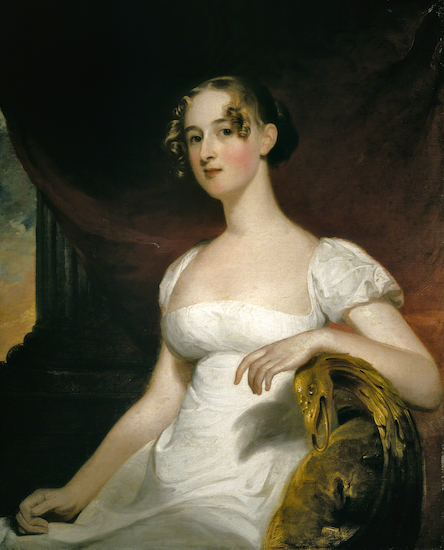 |
| Thomas Sully, Margaret Siddons Kintzing, 1812, oil on canvas, 91.6 x 73.8 cm Image © 2026 Worcester Art Museum (WAM-488) |
Sully's portraits are prime examples of the highly romanticized, painterly and fluid style that he saw in Britain in the portraits of Henry Raeburn (1756-1823) and particularly Thomas Lawrence (1769-1830), and that endured in popularity in the US through the 1800s. Although he painted many government and military bigwigs, Sully's fame rested on the exaggeratedly elegant, idealized portraits of elite society people. His portraits of these ultra-refined, affluent people document deliberately self-conscious affectations of the sitters, to the point where the artificiality precludes any psychological insight into their personalities.
This appealed greatly to such shallow, rich people who were his patrons, which is a great contrast to the unvarnished realism desired by elite portrait patrons during the pre-Revolution period (before 1775-1783). However, these flawlessly executed works, often aided in artificiality by dramatic lighting, earned Sully the status of being the most successful portrait painter in the US after Stuart died in 1828.
This is a portrait of the wife of Benjamin Harbeson Kintzing (about 1790-1825), son of a wealthy mercantile family in Salem, Mass. Margaret Siddons married Kintzing in 1811, and it was the practice at the time to have portraits painted as a commemoration of the marriage, although there is no portrait listed in Sully's records of ever having painted Mr Kintzing. Her older sister, Margaret (1788-1867) also had posed for Sully in 1812 without her husband.
Background
Art did not truly begin to flower in the American colonies until the early- to mid-1700s. During the 1600s and 1700s, painting consisted almost exclusively of portraits. In the earliest colonial painting, the colonists preferred a conservative painting style that reflected that of the Elizabethan (Renaissance) period in England, the primary subject matter of which was portraits. As prosperity increased during the early 1700s, colonists were able to afford luxury items such as finely-crafted furniture and clothing, finely decorated and built houses, and paintings. Also with the increase in prosperity came the desire by affluent people in the colonies to reflect the cultivated "latest" taste in painting of their counterparts in England.
After the American Revolution (1775-1783), the art of painting made great strides in expanding subject matter beyond portraits, and establishing an American style that was a unique blend of the Old World and the New. Instead of rejecting their European heritage, American artists conceived of American painting as a continuation of the same tradition, using American subject matter.
Many of the great portrait painters of the late 1700s had studied in England, and had adapted the Grand Manner to American portraiture, in a conscious decision to elevate American painting to the same level of academic "standards." They adroitly modified the American penchant for acutely observed, unvarnished realism with superficial trappings of classical antiquity and romantic elements of Renaissance and Baroque art. American artists now had a narrative to tell about heroes, historical incidents and international figures in painting, in a way that taught moral, religious, romantic or nationalistic lessons.
Thomas Sully was born in Horncastle, Lincolnshire, Britain, the son of two actor parents. The Sully family emigrated to the US in 1792, settling in Richmond, VA. Influenced by his portrait miniaturist brother Lawrence (1769-1804), Sully determined to be an artist. He first apprenticed (1794-1799) to French miniaturist Jean Belzons (active 1794-1812). After seeing the realist portraits of Henry Benbridge (1743-1812), he was determined to make a career as a portraitist rather than a miniaturist, opening a studio in Richmond in 1804.
In 1806, while fulfilling a commission in New York, he met Grand Manner (Romanticism) painters William Dunlap (1766-1839) and John Trumbull (1756-1843), whose work influenced him. In 1807, he studied for three weeks with the great Grand Manner portraitist Gilbert Stuart (1755-1828) in Boston. Stuart encouraged him to pursue portraiture. In the same year he moved to Philadelphia where he spent the rest of his life.
In Philadelphia Sully's portrait business flourished. In 1809 he embarked on a year-long study trip to London to help him incorporate the Grand Manner characteristics he had already seen in New York. In London he studied under the American expatriate Grand Manner painter Benjamin West (1738-1820). He also met the foremost British portrait painters of the period, and studied Baroque and Renaissance painting in British collections. Returning to Philadelphia in 1810, he quickly established himself as one of America's foremost portrait painters. During his career, he painted in numerous cities between Washington and New York. In 1851 he wrote a short book Hints to Young Painters and the Process of Portrait Painting.

Comments