
Artist Birthday: Sylvia Plimack Mangold (born 1938 US)
A large part of the early body of art work by Sylvia Plimack Mangold put the “real” in Photorealism. For awhile now, she has been producing lyrical studies of landscape and nature around her studio.
Artist Birthday for 18 September: Sylvia Plimack Mangold (born 1938 US)
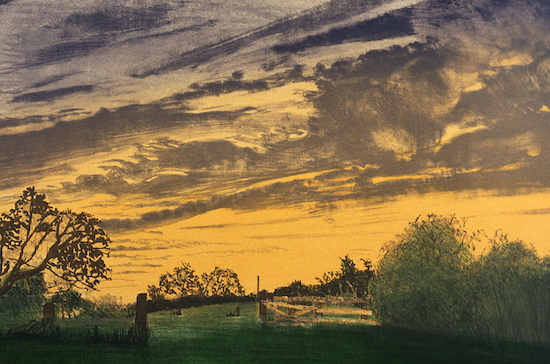 |
| Sylvia Plimack Mangold, Cropped Sunset with Plum Tree, 1981, silkscreen on paper, 75.6 x 106.7 cm Butler Institute of American Art, Youngstown, Ohio, © 2026 Sylvia Plimack Mangold (BIAA-533)
|
From 1977 to the present, Mangold has been painting elements of landscape in close-up and detail in the same meticulous focus as her studio and apartment floor paintings. Her earliest landscapes were foreground-middle ground-background, often cropped so that the entire subject of the title was not visible, like the sun in Cropped Sunset. She gradually began examining each of the layers of landscape, by the 1990s settling on close-ups of trees that grew around her house and studio in Washingtonville, NY. Because of the domination of the beautifully painted sky, the Plum Tree in this work is virtually an afterthought.
Background
The penchant for an acutely observed brand of realism has been present in all periods of American painting. From the earliest years of the colonies, American art patrons preferred down-to-earth, non-generalized depictions of subject matter with which they were familiar rather than any esoteric, philosophical, romantic or high-toned historical content (unless it glorified US history). Despite the widely held idea that Abstract Expressionism was the "only modern style" in America during the period after World War II (1939-1945), many artists persisted in stressing realism in their work before it was popular (as in Pop Art) to rebel against America's first indigenous modernist movement.
Pop Art's return to the object was ironic and often satirical. The Photorealism movement that evolved at the same time was less philosophical in its intent. Influenced by the prevalence of the camera and non-subjective nature of the modern photographic snapshot, Photorealist artists presented the world as a camera would see it, not as they saw it with emotional or ideological nuances.
Sylvia Plimack Mangold was born in the Bronx, New York, and grew up in Queens. Inclined towards art at an early age, Plimack drew as a child, and excelled in art at her progressive public school. She attended the Music and Art High School in the Bronx. Realizing that art was what she loved to do, she obtained a certificate from attending Cooper Union in New York (1956-1959). It was in the architecture class she took there that she first began to realize with her fascination with depicting space. She had an affinity for creating the illusion of space (three dimensions) on a flat (two-dimensional) surface.
Mangold received her BFA from Yale University in 1961. While at Yale she appreciated the work of artist's whose work was concerned with space, such as Fairfield Porter's (1907-1975) often un-peopled interiors and exteriors of architecture, or Edward Hopper's (1882-1967) landscapes and interiors devoid of human beings. Her earliest works ("schlock" as she once called it), were images from billboards in a Pop Art aesthetic.
She thereafter painted portraits and cityscapes. Her depiction of apartment houses fired once again her interest in depicting space. After the birth of a son which reduced the amount of time she could spend painting outdoors, her apartment and studio floors became her subject matter, meticulously detailed and glorious in the precisely delineated one-point perspective. After moving to the country around 1971, she began painting landscapes and then close-ups of nature with the same focus as her floor paintings.

Comments