
Artist Birthday: Sophie Ristelhueber (born 1949 France)
Since the development of photography art form in the early 1800s, the medium has been considered ideal for documenting reality. “Reality” includes wars. The earliest wars documented by photography were the Crimean War (1853-1856), and the American Civil War (1861-1865). Unfortunately wars have not become a thing of the past. Sophie Ristelhueber documented the awful aftermath of the Gulf War (1990-1991) in Kuwait.
Artist Birthday for 21 October: Sophie Ristelhueber (born 1949 France)
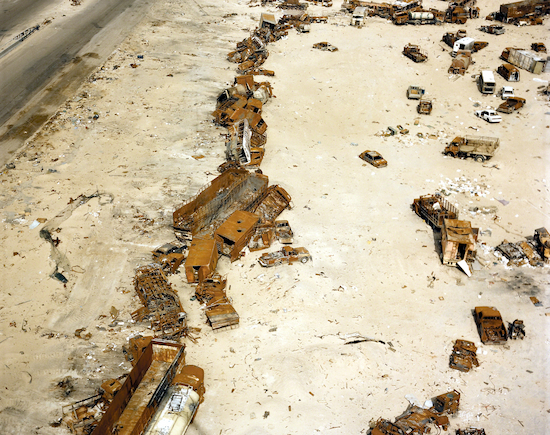 |
| Sophie Ristenhueber, Untitled, from the series FAIT, 1992, chromogenic color print, 101 x 125.7 cm Buffalo AKG Art Museum, Buffalo, NY, © 2026 Sophie Ristelhueber / Artists Rights Society (ARS), New York (AK-1707risars)
|
Ristelhueber was inspired to photograph in Kuwait after seeing an image in Time magazine of the impact of French bombs on the Kuwaiti desert during the Gulf War (1990-1991). In October of 1991, after the war was over, she traveled to Kuwait.
Of the 71 photographs in the series, the majority of them were taken while flying in a helicopter. Like the American photographers of the Civil War, she was photographing a battlefield after the fighting was over, showing the garbage and destruction left behind, without a trace of human presence. The overhead perspective in which there is (usually) no horizon, presents at first an abstract sensation of marks and lines in an unknown territory.
This view of the shocking number of vehicles left behind by "allied" and Iraqi troops creates a dystopic view of what exactly the war was initially about. Because the images in FAIT are not generally identifiable as Kuwaiti landscapes, the series -- which also became a book -- is not immediately recognizable as a diatribe against war, but rather an ironic aftermath of its effect on the natural terrain. It raises the specter in the global 21st century of the viewing public's being anesthetized to the violence of war, yet points out the lasting impact of such events on the regions in which they occur.
Background
In photography, the genre of the "grand landscape" evolved to perfection during the latter half of the 1800s in both Europe and America. Historically, the grand landscape owes its evolution to the photographers of the Crimean War (1853-1856) in Europe, and the American Civil War (1860-1865).
Photographers perfected techniques for photographing large panoramas with the help of horse drawn wagons that contained their darkrooms for preparing glass plate negatives. With contemporary photographic techniques, large scale landscape photography is considerably easier. Ironically, the subject matter seems to have come full circle from the mid-1800s.
The wars of the first three-quarters of the 1900s -- World War II (1939-1945), Korean War (1950-1953), and Vietnam War (1955-1975) -- were the most photographed conflicts since the American Civil War. Because of the negative impact of that photography on American public opinion, subsequent wars -- the Gulf War (1990-1991), Afghanistan War (2001-ongoing) and Iraq War (2003-ongoing) -- were censored by the American government. Much of the photography of these wars was done by independent photographic artists unaffiliated with news organizations.
The perception of "globalism" in the 2000s pertains more to the more convenient link globally by internet and cell phone, than it does to a global "Utopian" society. Globalism has actually aided documentation of world conflicts that no longer need to go through government-controlled media outlets or communications networks. Ironically, it has created a whole new genre of photography of conflict that is based more on the artist's subjective responses than to the documentary impulse.
Sophie Ristelhueber was born in Paris. She studied literature at the Sorbonne in the 1970s where she was greatly impacted by Alain Robbe-Grillet's (1922-2008) novel Jealousy. Jealousy was part of the New Novel literary movement, where novels consisted of the descriptions of the characters' effects on objects, rather than the character's inner feelings.
While working in the 1980s on Zoom visual arts magazine, she collaborated on Belgian artist François Hers' (born 1943) photographic project Interiors, in which French public housing interiors were photographed without human presence. This cemented the development of her mature photographic style.
For over thirty years, Ristelhueber has devoted her photography to the idea of territory and its history as reflected in the marks left by war or natural or cultural upheaval. Although not all her body of work involve these subjects, the major projects do.

Comments