Artist Birthday: Rudolf Belling (1886-1972 Germany)
Rudolf Belling is considered the outstanding example of modernism applied to classic sculpture subjects. He was influenced by Cubism, Neo-Plasticism, Constructivism, and De Stijl.
Artist Birthday for 26 August: Rudolf Belling (1886-1972 Germany)
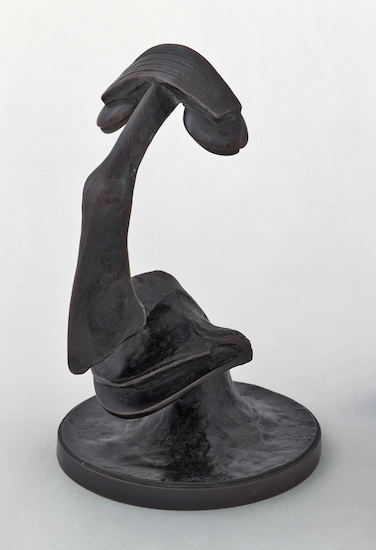 |
| Rudolf Belling, Portrait of Alfred Flechtheim, 1927, bronze, 19 x 12.7 x 12.1 cm The Museum of Modern Art, New York, © 2026 Artists Rights Society (ARS), New York (MOMA-S0616baaars) |
Alfred Flechtheim (1878-1937) was a Jewish art dealer and art collector who was persecuted by the Nazis. For Belling's "portrait" of the avant-garde art dealer and supporter of modern art, Belling removed the eyes, nose and lips completely from the shaped skull. Unlike his Skulptur 23 in which volume and space ruled the composition, Belling shows no interest in volume with Flechtheim, instead rather, he was fascinated by Flechtheim’s sharp facial features, his prominent nose, wide mouth and weak chin, and, in particular, his forehead.
Background
During the period before World War I (1914-1918), German sculpture moved away from the academic/romantic classicism that had dominated the art form during the 1800s. With Germany consistently a cauldron of boiling over political intrigues, many German artists sought to express their inner emotions about their culture in Expressionism, a style that distorted physical reality into jagged shapes, and jarring colors that intentionally sought an emotional response from the viewer.
Another style prevalent in Germany evolved after World War I, emphasizing extreme realism or satire to make political and social statements. This movement was called the New Objectivity, because for many artists it was a return to realism rather than exploring current modernist trends in European art such as Futurism, Constructivism and Surrealism. Both Expressionist artists and New Objectivity artists found their work condemned by the Nazis after they took power in 1933. What resulted was the Nazi ordered “Degenerate Art” exhibition in 1937 which prompted many German modernists to flee Germany.
Rudolf Belling was born in Berlin. He had acquired an apprenticeship as a locksmith, and also worked as a molder and modeler of small metalwork such as small sculptures and picture frames in the Art Nouveau style. In 1908 he opened up his own metalwork studio, being familiar with all metalworking techniques such as casting, etching, and engraving. Around that time he also produced sculptures, props and set designs for theater.
In 1911 he became a sculpture student at the Berlin-Charlottenburg Art Academy. Even while serving in World War I (1914-1918), he was able to continue producing sculpture. During that period he produced his first Cubist sculptures. He was also influenced by Italian Futurism, Russian Constructivism, and Dutch De Stijl. All of those styles reduced forms to basic geometric shapes. In 1918 he co-founded the November Group, radical leftists artists and architects who leaned towards Expressionism.
In 1931 Belling became a member of the Prussian Academy of Art, but, because he did not share the contemporary Nazi ideology, he was forced to resign. He was also banned from working in Germany after the rise of the Nazis in 1933, his work labeled “degenerate.” He emigrated to Istanbul in 1937, appointed the head of the sculpture school of the Art Academy of Istanbul. He did not set foot in Germany again until he was 80 (1966).

Comments