
Artist Birthday: Robert Kobayashi (1925-2015 US)
There were many Japanese-American artists who served in the US military during World War II (1939-1945) and afterwards became leaders in American modernism. Robert Kobayashi was a unique modernist who managed to escape the stranglehold Abstract Expressionism had on American modernism during the 1950s and 1960s.
Artist Birthday for 5 May: Robert Kobayashi (1925-2015 US)
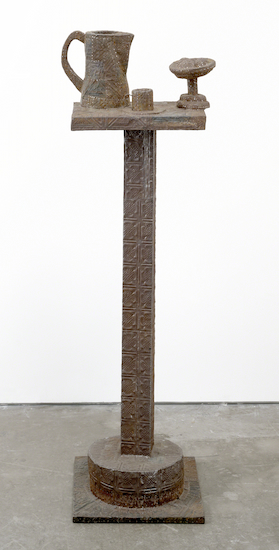 |
| Robert Kobayashi, Three Plums, found pressed-tin, nails and wood base, 158.1 x 53.3 x 43.8 cm The Museum of Modern Art, New York, © 2026 Artist or Estate of Artist (MOMA-S0046) |
After buying Moe's Meat Market in 1977 in Little Italy, New York, and making it into a gallery/studio space, Kobayashi drew his energy and materials from the streets of Little Italy developing a unique style of mixed media from found objects. The hammered tin works were dubbed clouage by a critic, taken from the French verb “to nail.” Using found metals and detritus, he cobbled together 2 and 3-D works from discarded ceiling tin as well as beer and Cafe Bustelo cans. Through bricolage -- the construction of a work of art from diverse objects and materials -- he depicts intimate moments, including three-dimensional still life, like Three Plums. The hammered surface of the tin gives his pieces an almost Pointillist appearance. From a distance, the raised nails and the geometric placement of the metalwork create an abstract pattern to be admired as an object itself.
Background
During the 1940s, a great shift occurred in American art. American Scene Painting, Regionalism, and Social Realism – which had dominated American art since World War I (1914-1918) – were suddenly eclipsed by new strains of non-objective abstraction in painting and sculpture. These new strains rejected the styles of geometric abstraction that had dominated European art between the wars.
Although Abstract Expressionism was practically canonized after World War II (1939-1945), many concurrent abstract styles – particularly by African American, Asian American, and women artists – were largely neglected in galleries and exhibitions. While Abstract Expressionism ultimately faded in importance (starting in the 1960s), these other abstract artists persisted and flourished.
Robert Kobayashi was born in Honolulu, Hawaii, to parents of Japanese descent. At a young age he demonstrated an inclination towards art in drawing cartoons. His older sister encouraged his art-making from childhood. After serving in World War II (1939-1945), Kobayashi went to New York (1950) to study at the Brooklyn Museum School. With no experience in gardening, he was hired by the Museum of Modern Art to tend a temporary display of a Japanese house and garden. He worked for MOMA until 1977 when he retired.
Kobayashi visited Paris in 1950. His view of European modernism from the early 1900s had a great impact on him, particularly Post-Impressionism. However, his interests developed independently from the concurrent European abstraction. In the late 1950s he exhibited canvases in an Abstract Expressionist mode, but soon decided to explore forms of expression more in tune with his own interests. Although his Abstract Expressionist works were well-received, he adopted a quirky, figurative approach.
For 20 years, Kobayashi alternated between Hawaii and New York. His pointillist period of the 1960s flowed into his metal and nail works of the 1970s that used found objects. During his Surrealist period, he produced small painted boxes. Throughout his life he produced art prolifically, finding some success. In 1977 he bought a building that had once housed a butcher shop and turned it into a gallery/studio to exhibit his work.

Comments